What is an active DAM? Why the age of passive content storage is over

Your digital asset management platform knows more about your content than anyone on your team. It knows which products are missing images. It knows which assets are off brand or out of date. It knows what’s been downloaded a thousand times and what’s never been opened.
And what does it do with that knowledge? Nothing.
That’s not a flaw in your particular DAM. It’s the defining trait of the entire category. For thirty years, digital asset management has been built on a single assumption: the system stores, and the users do the work of content lifecycle management. You put assets in. You take assets out. You tag, you sort, you export, you reformat, you re-upload. The DAM waits for you to take action.
The assumption held up when content moved at the speed of a quarterly campaign, before AI entered the chat. But it does not hold up now.
Passive DAM is a thing of the past
The DAM technology of the pre-AI era can be understood simply as “passive DAM”: a repository that holds your content but never acts on it. If a DAM is stuck in the past, it has a few key hallmarks to look out for when choosing a DAM platform.
Passive DAM is:
- Storage-first: Built to hold assets, not to do anything with them.
- User-initiated: Every workflow starts with a human deciding to start it; nothing happens proactively.
- Siloed: It lives apart from the tools your team actually works in, so getting content where it needs to go means exports and hand-offs.
- Manual at scale: The moment you need to change a thousand records, the “system” hands the job back to you and a spreadsheet.
Now, this doesn’t mean passive DAM didn’t serve a purpose. The DAM category has spent three decades getting deep, capable, and trusted in this passive state. But now, the problem with passive DAM is subtler and more costly.
Passive DAM platforms accumulate enormous knowledge about your content, but don’t convert any of it into action. It has everything it needs to manage your content autonomously. It just can’t do it (yet).
The hidden cost of passive DAM
The cost of a passive DAM is hidden because it doesn’t show up as a budgetary line item. It shows up as wasted bandwidth, inconsistency, and avoidable mistakes.
It’s the marketer who spends half a day downloading an asset, resizing it for six channels, and re-uploading six new versions, all for one campaign. It’s the catalog team spending hours week after week running CSV exports to update product attributes, then re-importing and praying nothing broke. It’s the agency that exists only to push listings to a marketplace one resubmission loop at a time. And, of course, it’s the documents nobody can find that go unused, or worse, recreated.
A passive system has no mechanism to surface or recover this vast, quiet waste or production spend.
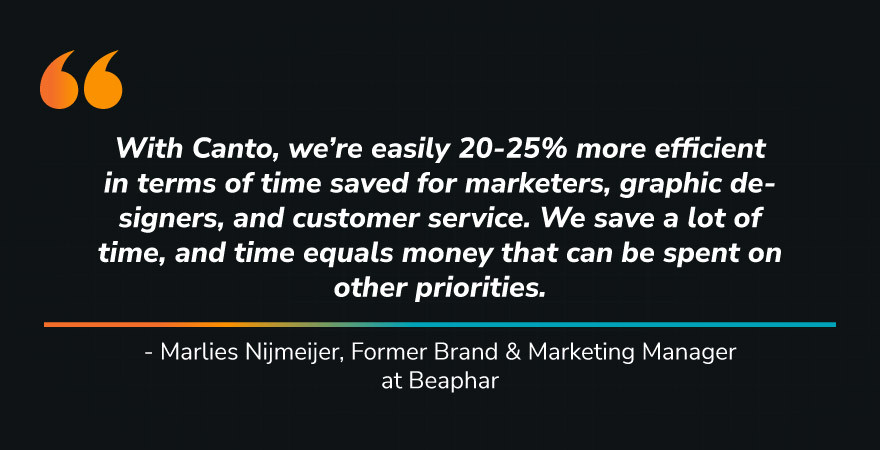
Every hour spent managing the system instead of the outcome is an hour the passive model quietly charges you. Multiply it across content operations, or an entire organization, and the number stops being a nuisance and starts being a budget sinkhole.
What changes with active DAM
Three things broke the passive model at roughly the same time:
- Content volume exploded. Brands now produce more assets, for more channels, under more brand and compliance scrutiny, than any manual process was designed to handle. The work scaled; the headcount to manage it did not.
- AI got good enough to act, not just assist. For most of the category’s history, “intelligent” DAM meant slightly better search. That’s no longer the ceiling. AI can now read a library, understand what’s in it, identify what’s wrong or missing, and carry out multi-step work on it, with a human approving the outcome rather than performing every step.
- Teams ran out of room to scale the old way. You cannot hire your way out of exponential content growth. The only path that survives the math is a system that absorbs the manual load instead of redistributing it back to people.
When those three forces met, the passive repository stopped being neutral and started being a liability.
The bright future of active DAM
A passive DAM answers “where is the file?”
An active DAM answers “what should happen to this content next?” and makes it happen.
This shift is from a system you manage to a system that manages work for you.
AI is embedded at every layer, not bolted on as a feature. Your team sets the outcome, the strategy, and the platform handles the steps and surfaces the results for review.
| Passive DAM | Active DAM |
|---|---|
| Stores assets | Acts on your assets |
| You initiate everything | AI surfaces what needs doing |
| Works in isolation | Extends across your stack |
| Manual execution | Prepares your content for launch |
| Limited by metadata | Makes every asset discoverable |
The distinction isn’t cosmetic. A passive DAM with AI search is still passive, it’s just faster at something you still have to initiate. An active DAM fundamentally changes who does the lion’s share of the work.
What active DAM looks like in practice
“Active” isn’t a single feature. It’s a posture that shows up across three dimensions of how content actually flows.
- It acts on your content. Instead of exporting a thousand records to a spreadsheet to make a change, you describe the change; the system finds the right records, you confirm, it’s done. The manual grind of bulk work moves from your team to the platform.
- It extends into your stack. A passive DAM is a destination you visit. An active DAM becomes part of the infrastructure your team and your other tools already rely on, so content, and the knowledge about it, stops being trapped behind separate logins.
- It delivers at scale. Nothing stays buried. Not images or videos, and, for the first time in most libraries, no documents. All content gets found and gets where it needs to go without a human shepherding every step.
None of this removes human judgment. It removes human busywork. The team stops managing the library and starts managing the outcomes, which was always the most important part of the job.
Canto: Leading the active DAM evolution
For Canto, active DAM isn’t a pivot. Instead, it’s a natural continuation built on three decades of watching how content teams actually work and careful study of the manual workarounds, broken hand-offs, and processes that existed only because the system wouldn’t do its share. That deep understanding is why Canto AI isn’t intelligence for it’s own sake. It’s intelligence targeted at the most pressing problems we’ve watched teams fight for decades.
Canto created the DAM category. Now, we’re reinventing it. The channels multiplied, the libraries got too big, and the manual load of managing both got far too heavy for the old model to bear. The only way forward is a system that absorbs the work instead of redistributing it back to your team; one that reads your content, understands it, tells you what needs doing, and (with your sign-off) does it.
That’s active DAM. That’s Canto.