
Agentic marketing: what it is and how to prepare
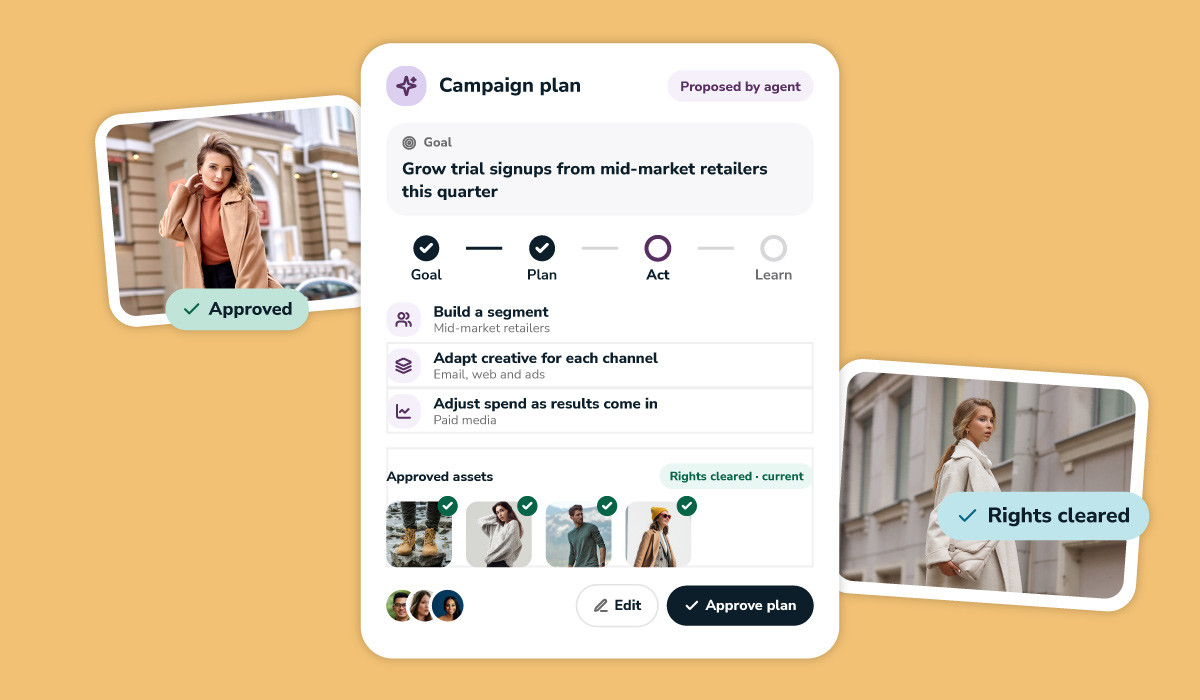
Agentic marketing is an approach where AI agents plan, execute ans optimize marketing work toward a goal you set, while people define the strategy and approve the results. Instead of following fixed if/then rules, agents reason through steps, use connected tools and adjust as results come in.
That sounds like a technology story, but it’s really a content story. Agents can only act on what they can find, understand, and trust. If your asset library is scattered, untagged or out of date, an agent will work form the same mess your team does, only faster. This guide explains what agentic marketing is, how it differs from automation and generative AI, and how to get your content ready for it.
What is agentic marketing?
Agentic marketing uses takes AI marketing a step further by using autonomous AI agents to carry out multi-step marketing work with limited human input. You give an agent a high-level goal, such as “grow trial signpups from mid-market retailers this quarter.” The agent breaks that goal into tasks, picks the tools and content it needs, takes action across channels and checks the results.
Four traits set agentic marketing apart:
- Goal-driven: The agent works toward an outcome, not a single prompt or a scheduled trigger.
- Multi-step reasoning: It plans a sequence of actions and changes course when something isn’t working.
- Tool use: It connects to the systems your team already relies on, such as your CRM, ad platforms, email tools and content library.
- Feedback loops: It learns from performance data and applies what it learns to the next round.
The human role doesn’t disappear. People set strategy, define guardrails and give final approval. A marketer who works this way is sometimes called an agentic marketer: someone who manages outcomes and oversees agents instead of executing every task by hand.
Agentic marketing vs. marketing automation vs. generative AI
These three terms get mixed up, so it helps to compare them side by side.
| Marketing automation | Generative AI | Agentic marketing | |
|---|---|---|---|
| Driven by | Present rules and triggers | A single prompt | A goal |
| Scope of work | One repeatable task or sequence | One output, such as a draft or an image | A multi-step workflow across channels |
| Adapts to results? | No, until someone edits the rules | No, until someone writes a new prompt | Yes, through feedback loops |
| Human role | Builds and maintains the rules | Writes prompts and reviews outputs | Sets strategy and guardrails, then approves results |
The three aren’t rivals. Agentic systems often use generative AI to produce content and automation to run steps reliably. What’s new i sthe layer on top that decides what to do next.
How agentic marketing works
Most agentic marketing systems follow the same basic loop.
Setting a goal
A person defines the objective, the audience, the budget and the boundaries. Clear guardrails matter here, because they tell the agent what it must never do.
Crafting a plan
The agent turns the goal into a set of tasks. It decides which content to use, which channels to prioritize and which other agents or tools to involve
Taking action
The agent executes. It might build a segment, adapt creative for a channel, adjust spend or send a lifecycle message. Each action draws on connected systems and, critically, on content.
Learn and iterate
The agent reads performance data, compares it with the goal and adjusts. Results feed back into the next plan, so each cycle starts from a better position.
How teams use agentic AI in marketing
Teams are applying agentic AI to work that is repetitive, data-heavy and spread across many channels. Common use cases include:
- Personalization at scale: Agents deliver personalized marketing by matching content and offers to individual audiences across email, web and ads.
- Campaign and paid media optimization: Agents shift budget and adjust bids based on live performance.
- Lifecycle marketing: Agents run onboarding, nurture and retention programs that adapt to each customer’s behavior.
- Content adaptation and localization: Agents resize, reformat and localize approved assets for each market and channel
- Always-on engagement: Agents respond to inbound questions and route conversations to the right people at any hour.
Nearly every one of these depends on the same thing: the right content, in the right state, available at the moment the agent needs it.
Why content is the bottleneck for agentic marketing
Most conversations about agentic marketing focus on what agents can do. Fewer address what agents need in order to do it safely. An agent that can launch a campaign in minutes can also publish the wrong asset in minutes.
Consider what happens when an agent pulls from a library that isn’t ready:
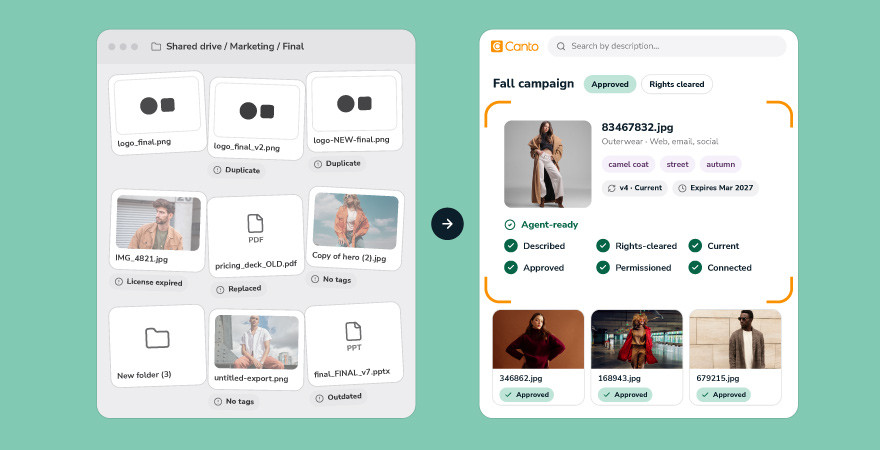
- It selects an image whose license expired last month.
- It uses an old logo because three versions look nearly identical.
- It builds a campaign around a pricing deck that was replaced weeks ago.
- It can’t find the approved product photo, so it generates a new one that doesn’t match brand guidelines.
None of these are AI failures. They’re digital asset management (DAM) failures that AI makes faster and more visible. Agents also can’t ask a colleague which file is the real one. They rely on what the system says about each asset: its metadata, status, rights and permissions.
That’s why content readiness, not model choice, often decides whether agentic marketing delivers value or creates cleanup work.
The agent-ready content checklist
Use these six criteria to judge whether your content library can support agentic marketing. If an asset fails any of them, an agent can’t use it reliably.
- Described: Every asset has accurate, consistent metadata: what it shows, who it’s for, which product or campaign it belongs to and where it can be used. Agents search by meaning and metadata. Without descriptions, a great asset is invisible.
- Rights-cleared: Usage rights, licenses and expiration dates are recorded and enforced. An agent should be able to see at a glance whether an asset can be used in a given channel or region.
- Current: Version control makes it obvious which file is the latest. Outdated and duplicate files are flagged or retired so an agent never has to guess.
- Approved: Approval status is explicit and tied to the asset. Agents should only draw from content marked approved, and anything an agent creates should go through review before it’s published.
- Permissions granted: Access rules define who and what can see, edit and distribute each asset. Agents should inherit the same role-based permissions as your team, and no more.
- Connected: Content is reachable from the tools agents use, through integrations and standard connectors. A library locked behind its own login is a library agents can’t work from.
How to get your content ready for agenti marketing
You don’t need to fix everything before you start. A practical sequence looks like this:
- Audit your library. Find out how many assets are missing metadata, rights information or approval status. Prioritize the content your top campaigns use most.
- Close the gaps in bulk: Use AI-assisted tagging and bulk editing to enrich metadata and flag duplicates, instead of fixing assets one at a time.
- Set the rules once. Document brand guidelines, rights terms, expiration dates and approval requirements in your asset management system so they travel with the content.
- Connect your tools: Make sure the platforms your agents use can reach your governed library directly.
- Keep people in the loop: Define which actions agents can take alone and which need human approval, then review results regularly.
How Canto helps make content agent-ready
Canto is an active digital asset management (DAM) platform. Where a passive DAM stores assets and waits for people to act, Canto acts on your content, extends into your stack and delivers at scale. That makes it a natural foundation for agentic marketing, because it addresses each part of the checklist. Read more about what an active DAM is and how it differs from passive storage.
- Described: Canto AI Library Assistant categorizes tags and organizes your library automatically, and Smart Tags identify image content with AI. Canto AI Visual Search lets people and tools find assets by describing them in plain language.
- Rights-cleared: Digital Rights Management tracks licensed assets and required terms of use, and content controls mark assets as approved, restricted or auto-expiring.
- Current: Version control helps teams work from the latest approved asset, and Canto Global Assistant flags duplicates and gaps as assets arrive.
- Approved: Canto Approval Hub brings proofing, markup, version comparison and approval routing into one place, so approval status stays attached to the asset.
- Permissions granted: Role and group-based access controls, expiration dates and secure sharing keep AI working only with the content it’s supposed to touch.
- Connected: Canto extends into any AI-powered tech stack so AI tools can work from a governed content library, and 40+ integrations connect Canto to the creative, CMS, CRM and project management tools your team already uses.
Two more capabilities matter once agents start acting. Content Readiness shows a live health view of your library and fixes gaps in bulk once a human approves the changes. Canto Brand Studio gives non-designers AI templates with locked brand elements, so on-brand content can be produced without pulling designers into every request. Canto Media Publisher then delivers assets in the right format for each channel automatically.
The result is a library that people and AI tools can both trust. Your team manages the outcomes while the platform handles the work in between.
See how an active DAM prepares your content for AI agents. Take a tour of canto.
Agentic marketing frequently asked questions
What is agentic marketing? Agentic marketing is an approach where autonomous AI agents plan, execute and optimize marketing work toward a goal. People set strategy and guardrails and approve the results. it differs from marketing automation, which follows fixed rules, and from generative AI, which produces a single output from a prompt.
How can agentic AI be used in marketing? Teams use agentic AI for personalization, paid media optimization, lifecycle campaigns, content adaptation and localization and always-on customer engagement. These use cases work best when the agent can draw on organized, approved and rights-cleared content.
Is ChatGPT an agentic AI? A chatbot that answers on prompt at a time is generative AI. It becomes agentic when it’s set up to pursue a goal across multiple steps, use connected tools and act on results. The same underlying model can be used either w/ay.
Which agentic AI platform is best for marketing? There isn’t one answer, because it depends on your goals, your existing tools and how ready your data and content are. Evaluate platforms on how well they connect to your stack, how much control they give you over guardrails and approvals, and whether they can work from governed content.
Is it legal to use AI for marketing? In general, yes, but rules vary by region and by use case. Areas to watch include privacy and consent, disclosure of AI-generated content and intellectual property and licensing for the assets involved. Talk to your legal team about requirements that apply to your business.