Fashion branding: Complete guide to building a powerful fashion brand identity
| March 2, 2026
What is fashion branding?
Fashion branding is the strategic process of creating a distinct, recognizable identity that emotionally connects with customers and differentiates your fashion business from competitors in the $369 billion fashion industry, according to Statista. Whether you’re launching a new clothing line or repositioning an established company, your brand identity determines whether customers choose your clothes over countless alternatives.
This guide covers strategic brand building from:
- Concept to execution
- Targeting fashion entrepreneurs
- Fashion brand managers
- Marketing professionals who want to create lasting brand value
We’ll explore everything from foundational brand values to visual identity development, while leaving specialized topics such as supply chain management and production processes to other resources.
Strong fashion branding matters even more in today’s cost-conscious environment. Business of Fashion reports that more than 60% of consumers in the US and UK say they are actively trying to save money on fashion, with that figure reaching 75% in the US. As shoppers become more selective about where and how they spend, brands must offer a clear identity and differentiated value to earn their purchase.
Direct answer: Fashion branding is the strategic process of creating a unique, recognizable identity that emotionally connects with customers and differentiates your fashion business from competitors through consistent visual, verbal, and experiential elements.
By the end of this guide, you’ll understand:
- The fundamental components that make a fashion brand identity different from traditional product branding
- How to build a strategic foundation with brand values, target audience research, and market positioning
- The step-by-step creative process for developing cohesive visual identity systems
- Implementation strategies for maintaining brand consistency across all channels
- Solutions to common challenges that fashion companies face in competitive markets
Understanding fashion branding fundamentals
Fashion branding sits at the intersection of emotional storytelling, visual identity, and strategic positioning in a market where customers don’t just buy clothes — they buy into a lifestyle, a sense of identity, and a community.
Unlike purchasing household goods, fashion purchases are deeply emotional decisions tied to self-expression and how people want the world to perceive them.
What is fashion branding?
Fashion brand identity encompasses every element that shapes how customers perceive and experience your brand, from the logo on your packaging to the personality conveyed in your social media posts. It’s the cohesive narrative that connects your design philosophy, customer service approach, and marketing campaigns into a unified brand experience.
Consider how different fashion companies approach branding:
- CHANEL exemplifies timeless luxury through its interlocking CC logo, black-white-gold color palette, and heritage storytelling rooted in Coco Chanel’s rebellion against convention
- LOUIS VUITTON pioneered monogrammed designs in 1854 to signal exclusivity and combat counterfeiting — a strategy still essential to the brand’s identity today
- Supreme, conversely, built its brand around streetwear culture, scarcity, and the fusion of art with fashion, creating a brand stance that resonates with younger consumers seeking authenticity over tradition
Core components of fashion brand identity
Visual elements form the most immediately recognizable aspects of a fashion brand. This includes your logo (a simple, memorable symbol that evokes style and emotion), typography (fonts that mirror your brand personality), a color palette (like Chanel’s elegant black-and-white with gold accents that convey luxury), photography style, and packaging design.
These elements must work together to create instant recognizability, whether customers encounter your brand in-store, online, or at fashion shows.
Brand personality and voice determine how your brand communicates. This encompasses your tone in marketing materials, the values you convey, your mission statement, and your storytelling approach. Ralph Lauren, for example, sells American aspiration — the brand’s voice consistently evokes a sophisticated, traditional lifestyle that customers want to inhabit.
Brand experience covers every touchpoint where customers interact with your company, from website navigation to customer service quality. Luxury brands like Hermès create exclusive events and personalized shopping experiences that reinforce their premium positioning, while accessible brands focus on convenience and community-building.
Fashion branding vs traditional product branding
Fashion branding differs from traditional product branding in several crucial ways. The fashion industry operates on seasonal cycles, requiring brands to stay relevant and adapt to fashion trends while maintaining a consistent core identity.
This balance between trend responsiveness and timeless brand elements demands strategic creativity that functional product brands rarely face.
The importance of visual storytelling in fashion is reinforced by social media behavior. According to a RetailDive report highlighting Instagram’s impact on consumer behavior, 72% of users say they’ve purchased fashion, beauty, or style-related items after seeing them on the platform. The most commonly bought categories include:
- Clothing
- Makeup
- Shoes
- And jewelry
This underscores how strongly purchase decisions are shaped by visual content, making a compelling digital brand identity essential for fashion labels aiming to convert inspiration into sales.
Understanding these fundamentals prepares you to build a strategic foundation that will guide every subsequent branding decision.
Building your fashion brand foundation
Before designing logos or selecting color palettes, you must establish a brand strategy that will inform every creative decision. This groundwork ensures your visual identity authentically represents your brand values rather than merely following aesthetic trends that may not resonate with your target audience.
Defining brand values and mission
The first step in building a strong brand identity is identifying authentic brand values that genuinely resonate with your target customers. These values should guide product development, partnerships, and all brand communications — they’re not marketing slogans but operating principles that shape how your company operates.
Consider how sustainability has become foundational to Patagonia’s identity. The company has committed to phasing out virgin petroleum-based materials wherever possible and replacing them with “preferred materials” — fibers and raw inputs that reduce environmental impact and generate greater benefits for climate, nature, and people compared to conventional alternatives.
In 2018, fewer than half of Patagonia’s materials met this preferred standard, with a goal of reaching 100% by 2025. According to its Fiscal Year 2025 data, 84% of its fabrics and trims are now made with preferred materials, most of which are backed by third-party certifications. This long-term commitment to material innovation reinforces Patagonia’s environmental stance and strengthens its credibility with eco-conscious consumers.
Luxury brands take different approaches: Hermès emphasizes artisanal scarcity with waitlists for Birkin bags, making exclusivity and craftsmanship their defining values. Emerging designers might focus on innovation, inclusivity, or cultural heritage.
Whatever values you establish must be authentic — customers quickly recognize and reject inauthentic positioning, as demonstrated by the backlash brands face for greenwashing claims.
Identifying your target customer
Effective fashion branding requires a deep understanding of who you’re designing for. Market research methods include:
- Customer surveys
- Social media analysis
- Focus groups
- Competitor customer analysis
The goal is to create detailed customer personas that capture demographics, psychographics, shopping behaviors, and brand preferences.
Understanding your target audience’s lifestyle is essential. How does fashion fit into their identity and daily life? What other brands do they love, and why? A woman buying a CHANEL jacket and one purchasing Patagonia outerwear may have similar incomes but vastly different motivations, values, and lifestyle aspirations. Your branding must speak directly to your specific customers’ sense of self.
Consider your audience’s shopping behavior: Do they discover brands through Vogue editorials, influencer recommendations, or friend referrals? Do they prefer exclusive events or accessible online shopping? These insights shape not just what you design but how you communicate and sell.
Competitive analysis and market positioning
The fashion industry is a competitive field where differentiation determines success. Analyze your direct and indirect competitors’ branding strategies, pricing, and market positioning to identify gaps and opportunities.
A helpful framework examines:
- Visual identity: How do competitors present themselves visually? What aesthetic territories are crowded versus underexplored?
- Brand positioning: Where do competitors sit on the luxury-accessible spectrum? What values do they emphasize?
- Customer experience: How do competitors engage customers before, during, and after purchase — and how do their tools, like DAM and CMS platforms, work together to support those experiences?
- Pricing strategy: What price points dominate your target market, and where might opportunities exist?
Your unique selling proposition should articulate what makes your brand stand apart. This might be a distinctive design aesthetic, superior sustainability credentials, innovative materials, cultural authenticity, or a unique lifestyle alignment.
LOUIS VUITTON’s collaboration with Supreme in 2017 illustrates how brands can find new positioning through unexpected partnerships — that collaboration generated $100 million in sales by fusing streetwear with luxury in ways neither brand could achieve on its own.
With a strategic foundation established, you’re prepared to translate these insights into tangible brand assets, building on core brand management principles that keep your identity strong over time.

Creating your fashion brand identity system
Strategic foundation translates into the tangible brand assets and experiences that customers encounter. This creative process transforms abstract values into visual and verbal elements that consistently communicate your brand personality across every touchpoint.
Visual identity development process
Begin visual brand identity development only after your strategic foundation is solid. Otherwise, you risk creating aesthetically pleasing designs that don’t authentically represent your brand values or resonate with your target brand persona.
- Create mood boards that reflect your brand personality and your target customer’s aesthetic preferences. Gather imagery, textures, colors, and references that capture the feeling your brand should evoke. Include competitor visuals to ensure differentiation.
- Design logo concepts with variations for different applications. Your logo needs versions for digital use, print materials, product labels, and accessories. Consider how the logo appears at various sizes — from website favicons to store signage. Think of how Nike’s swoosh works equally well on a shoe as on a billboard.
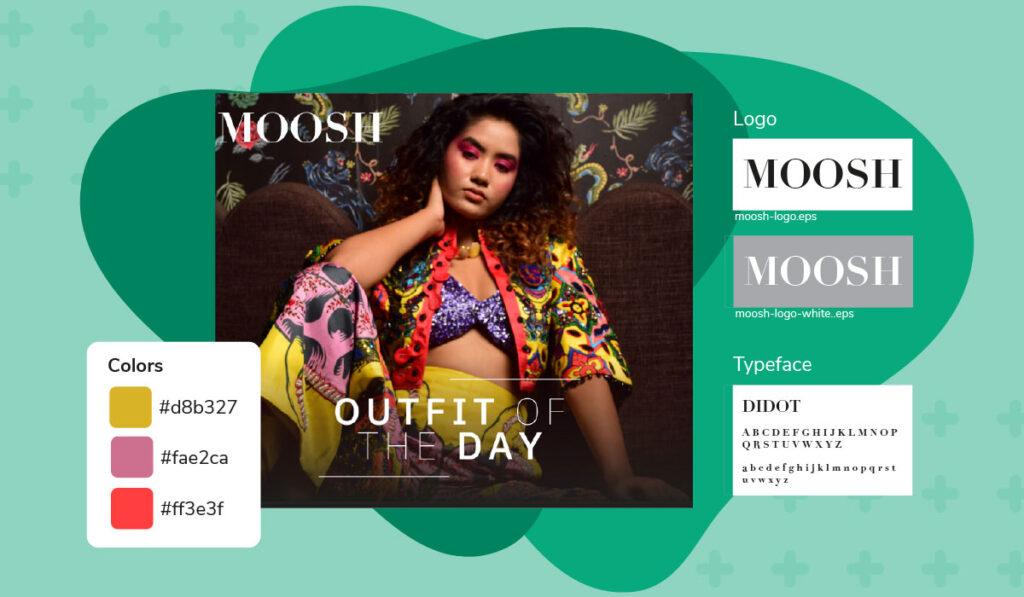
- Develop your color palette with primary, secondary, and accent colors, along with specific usage guidelines. Include exact Pantone references and hex codes for digital applications. Your colors should evoke appropriate emotional responses — black and gold suggest luxury, earth tones convey sustainability, bold primaries signal youthful energy.
- Select typography hierarchy for headers, body text, and specialty applications. Typography communicates brand personality — compare the serif elegance of Balmain’s logo with Calvin Klein’s minimalist sans-serif to see how fonts convey different sensibilities.
- Create photography and graphic style guidelines for consistent visual storytelling. Define lighting approaches, model casting direction, composition rules, and editing styles that ensure all visual content feels cohesive.
Brand voice and messaging strategy
Brand voice characteristics should feel like natural extensions of your brand personality. Define whether your tone is:
- Authoritative or approachable
- Playful or serious
- Aspirational or accessible
Be sure to document specific words and phrases that align with your brand, as well as those to avoid.
Create messaging frameworks for different customer touchpoints. Your product descriptions, social media assets, email marketing, and customer service responses should all feel like they come from the same brand, even as they adapt to different contexts and channels.
Compelling brand storytelling in fashion draws from heritage, designer vision, cultural references, or customer aspirations. Luxury brands often emphasize history and craftsmanship — the brand story behind the product. Emerging labels might focus on the designers’ creative journey or the community their clothes serve.
Whatever narrative you develop must feel authentic and consistently reinforced across all channels.
Brand asset management and consistency
Consistent brand application across all touchpoints builds brand recognition and trust. A customer encountering your brand on Instagram, in a retail store, and through email should have a unified brand experience that reinforces the same identity.
| Asset type | In-store application | Digital application |
|---|---|---|
| Logo usage | Signage, packaging, price tags, shopping bags | Website, social media profiles, email headers |
| Color palette | Store design, product displays, and staff uniforms | Website design, digital ads, app interface |
| Typography | Print materials, labels, receipts | Website copy, social posts, email campaigns |
| Photography | Lookbooks, store imagery, window displays | E-commerce product shots, social content |
Comprehensive brand guidelines ensure your team — whether internal designers or external manufacturers and agencies — applies brand elements consistently. Include specifications for:
- Logo placement
- Color usage in different contexts
- Typography sizing
- And photography standards
Regular brand audits identify inconsistencies before they erode the cohesive identity you’ve built. Maintaining this brand consistency becomes increasingly challenging as your brand grows and operates across more channels.

Common fashion branding challenges and solutions
Every fashion brand faces obstacles in building and maintaining a strong brand identity. These challenges affect companies across different sizes and market segments, from emerging designers to established fashion companies.
Brand differentiation in saturated markets
Solution: Focus on authentic storytelling and unique brand values rather than following competitors or chasing every trend. The most successful brands develop signature design elements or brand codes that become instantly recognizable over time.
Gucci’s art collaborations — such as its collaborations with Yayoi Kusama — blend heritage with new ideas to engage younger customers while maintaining brand distinctiveness.
JOAN notes that these collaborations boosted social media engagement. As a result, store traffic climbed 40%, while accessory sales rose by 27%.
Maintaining consistency across multiple channels
Solution: Create comprehensive brand guidelines and centralized brand assets in a digital asset management system. A digital asset management platform stores, organizes, searches, manages, and distributes your brand’s digital assets — giving your team easy access to approved logos, templates, photography, and messaging frameworks while unlocking key benefits of DAM like faster workflows, better collaboration, and stronger brand consistency. DAM is the foundational technology that enables fashion retail brands like Lalique and Victoria to manage their brands from a single place.
Also, conduct regular brand audits across e-commerce platforms, social media accounts, retail locations, and partner materials to ensure you’re consistently applying your brand elements across every channel.
Inconsistency confuses customers and dilutes the brand recognition you’ve worked to establish. Marq reports that brands maintaining visual consistency can see up to a 23% increase in revenue.
Balancing trendy elements with timeless brand identity
Solution: Establish core brand elements that remain constant — your logo, primary colors, typography, and fundamental values — while allowing flexibility in seasonal campaigns and product collections.
Use trend elements in temporary applications, such as limited-edition products or campaign imagery, while maintaining your consistent brand foundation. This approach lets you stay ahead of fashion trends and stay relevant without making necessary changes to your core identity every season.
Brands that chase trends too aggressively risk the fate of Juicy Couture, whose velour tracksuit identity couldn’t survive beyond its cultural moment.
These challenges require ongoing attention as your brand evolves in a constantly changing market.
Why Canto DAM is the best brand management technology for fashion teams in 2026
For fashion brands ready to modernize their brand operations, Canto DAM delivers an all-in-one platform that unites digital assets, brand guidelines, and creative workflows in one centralized system, backed by Canto’s 30+ years of DAM leadership and customer-centric innovation.
Embedded with powerful AI, Canto gives fashion entrepreneurs, brand managers, and marketing teams the agility and governance they need to produce and manage on-brand content across seasonal launches, global campaigns, retail environments, and e-commerce channels by leveraging Canto AI’s intelligent search, tagging, and automation.
In a competitive industry where identity is everything, consistency is what separates recognizable brands from forgettable ones. The most successful companies — from Louis Vuitton to emerging sustainable labels — don’t just define a strong identity. They operationalize it across every touchpoint.
With Canto, fashion teams accelerate brand management at every stage:
- Create faster: Canto Brand Studio empowers marketers and e-commerce teams with AI-powered brand templating to produce seasonal and localized content that stays aligned with brand guidelines
- Collaborate efficiently: Canto Approval Hub centralizes proofing, version control, and approvals — reducing bottlenecks between designers, marketers, agencies, and retail partners
- Organize better: Canto AI Library Assistant automatically categorizes and tags logos, lookbooks, campaign imagery, and product photography for structured organization, helping teams build a scalable digital marketing asset library
- Search instantly: Canto AI Visual Search retrieves approved assets using natural language queries, helping teams quickly locate the right visuals without digging through folders
- Distribute quickly: Canto Media Publisher automatically resizes and formats images and video for e-commerce platforms, social media, email campaigns, and retail systems — accelerating your latest collections to market
Successful fashion branding requires more than a compelling logo or seasonal aesthetic. As your company grows, it demands a strategic foundation, a cohesive visual identity, and disciplined brand governance.
Canto gives fashion teams the infrastructure to protect, scale, and strengthen their identity — so your brand promise isn’t just defined, but consistently delivered everywhere your customers encounter your brand.