Canto vs. Air
Canto is the #1 DAM for small business on G2, purpose-built for the full content lifecycle with the governance, integrations, support, and predictable pricing teams need.

Two DAM platforms compared across governance, integrations, support, pricing, transparency, and long-term scalability.
Canto and Air are both digital asset management (DAM) platforms, but they are built around fundamentally different assumptions about what a DAM platform should do. Air is positioned as a lightweight content workspace for creative teams moving fast. Canto is the platform teams move to when they realize speed isn’t enough. Over time, Air users discover governance gaps, integration strain, and compound cost. Overall, a DAM platform is a multi-year infrastructure investment, and the library that feels manageable at the start looks very different at scale. Canto is built to succeed on day one through day 1,000, with the governance, integrations, and operational complexity that accumulate as an organization grows.
Who is Canto?
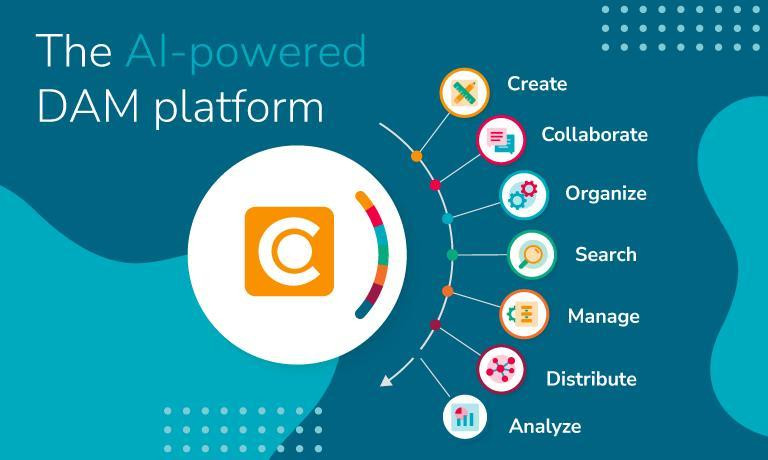
Canto is the original DAM pioneer, with 30+ years of DAM expertise and 4,000+ brands worldwide. As a DAM-first company, Canto’s industry-leading, AI-powered platform is purpose-built for digital asset management at scale. The platform combines AI-powered search, unlimited Portals, built-in workflow approvals and templating. DAM for Products, and dedicated implementation support. Canto is built to serve as the long-term hub for an organization’s content operations, across every team, every vertical, and every stage of the content lifecycle.
Who is Air?
Air is a content workspace founded in 2018. The platform is built around a visual, card-based interface and real-time collaboration tools aimed primarily at small creative teams. Air offers AI-enriched tagging, a natural language editing tool called Air Canvas, and a credit-based pricing model in which storage, AI enrichment, and AI generation each consume credits at different rates. Air markets itself as an approachable entry point for teams new to organizing digital content, but any team looking to scale will quickly outgrow its functionality. That low-friction, minimal-infrastructure approach works within a narrow set of constraints. When needs inevitably expand, its limitations show quickly.
What are the key differences between Canto vs. Air?
- Supporting the full content lifecycle beyond creation. Canto supports every stage of the content lifecycle: from ingestion and organization to governance, distribution, and analytics. Air focuses primarily on the creation and collaboration phase, without the governance infrastructure, portal distribution, or deep integrations that make a DAM platform work across a full organization over time.
- Predictable pricing. Canto offers transparent, inclusive pricing. Air’s credit-based model means storage, AI enrichment, and AI generation each dram from the same credit pool at different rates, creating pricing that is difficult to forecast, especially as teams scale. Prospects have reported renewal increases of up to 3x the original contract.
- A platform that grows with you. Canto is purpose-built for the complexity that comes with scale: structured metadata, granular permissions, approval workflows, unlimited Portals, and dedicated support at every contract size. Air is designed for small teams with lightweight needs and minimal process requirements. The gap between what Air offers and what a full DAM like Canto provides becomes visible, and costly, as organizations grow.
Canto vs. Air feature comparison
Canto is the #1 DAM for small business on G2 in Fall 2026, which makes the feature gap that follows all the more meaningful. The table below compares Canto vs. Air across the categories most relevant to DAM buyers evaluating mid-market solutions.
| Feature | Canto | Air |
|---|---|---|
| Search | AI Visual Search across images and video; hybrid search; facial recognition; reverse image search; natural language queries | AI-powered search with AI tags and descriptions; facial recognition; AI video search reliant on transcripts; AI-generated Smart Summaries that cannot be edited; no reverse image search |
| Asset organization | Folders, AI-assisted metadata based on existing taxonomy, AI-assisted categorization for new uploads at scale, and Smart Tags | Visual, card-based board structure; flat organization; limited taxonomy controls at scale |
| DAM for Products | Built-in; no third-party integration needed | No native product information capability; no integrations with PIM software |
| Brand management | Unlimited Portals and Style Guides included in core plan; AI-powered brand templates for on-brand content creation with Brand Studio | Portal-like functionality through Showcases, with limited branding or customization for lower tiered plans (share links also available for content distribution); Air Canvas for content creation but no guardrails to enforce brand standards |
| Digital Rights Management | Included in core platform; usage rights, expiration dates, watermarking, download controls, audit logging | Basic custom fields for usage rights and expirations; no watermarking |
| Workflow, approvals & distribution | Built-in approval workflows with Approval Hub, annotations, versioning, automated distribution for video and images with Media Publisher | Kanban-style commenting; no multi-step or sequential approval workflows; CDN capability that supports JPG, PNG, and WEBP formats |
| Analytics & reporting | Built-in usage insights for all customers | Limited to basic download counts only; no engagement analytics |
| Implementation | White-glove onboarding led by dedicated Canto DAM specialists; structured implementation plan offered to every account | DIY self-service setup; minimal guided onboarding; dedicated support only on Enterprise plan (Air) |
| Customer resources | Canto Academy: tactical tutorials on DAM features and overall DAM strategy from Canto DAM experts | Basic help documentation; no dedicated learning platform or DAM-specific training program |
| Customer support | Dedicated AMs and tailored implementation support offered for every account | Email and chat support; dedicated onboarding and customer success restricted to higher tiered plans |
| Pricing model | Transparent, flat; unlimited users and Portals; no credit system | Credit-based model; storage, AI enrichment and AI generation consume credits at variable rates, up to 3x initial cost in some scenarios |
| Security & permissions | Granular role-based access control (RBAC) at folder, album, and asset level; single sign-on (SSO), multi-factor authentication (MFA), audit logging | Single sign-on (SSO) on higher-tiered plans only; basic permissions; no granular folder-level access control |
| Vendor focus | Independent, DAM-first company with 30+ years in the category focused on optimizing the entire content lifecycle | Content workspace product founded in 2018; primary focus on creative team collaboration and content creation |
A DAM that grows with you
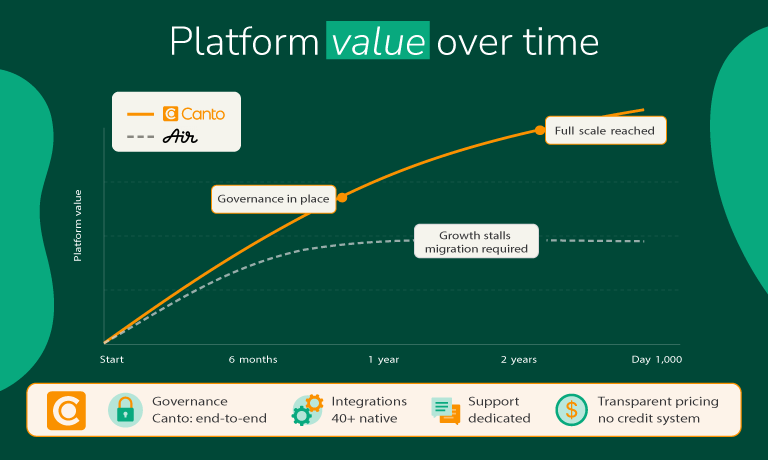
There is a version of the DAM evaluation where Air looks like the right answer. The interface is clean. The price of entry is low. Small teams can get up and running on their own. But the DAM decision is not a six-month decision; it is a multi-year infrastructure investment. The platform that feels frictionless at the start can become the bottleneck that forces a costly migration later.
Canto
Canto is built for the complexity that comes with scale: purpose built, intuitive, and AI-powered across the full content lifecycle, so governance and infrastructure are in place and ready when your team needs them. Structured folder hierarchies, granular role-based access control, unlimited Portals for curated distribution, approval workflows, and a robust integration ecosystem are all included in the core platform. Canto AI offers the foundational AI-powered metadata and search capabilities every team needs from day one (with no credit system and no usage meter). As your needs grow that foundation extends into more powerful upgrade options: AI-powered brand templates, automated approvals, AI categorization and metadata recommendation, unified hybrid search, and advanced distribution tools, all on a pricing model that remains defined and predictable.
That predictability matters more than you think at the outset. Investing in a cheaper platform without the governance, integrations, or AI depth growing teams need may seem financially savvy. However, if that budget goes into a platform with unpredictable, usage-based pricing, the savings you expected disappear fast, and you’re left with a platform that still can’t do what you need it to do. That unexpected spend would have covered a full-feature DAM from day one, with room to invest in the advanced capabilities that become valuable over time. With Canto, you don’t have to choose between affordability and capability. You start with both and maintain the option to expand. The platform you deploy on day one is the platform that handles the demands and fits the budget of day 1,000.
Air
Air’s lightweight, folder-less board structure may be easy to set up, but it’s just as easy to outgrow. The same design choices that make Air fast to deploy, including minimal structure, limited taxonomy, and no approval workflows, are the ones that create friction when governance, metadata depth, comprehensive integrations, and distribution controls become requirements. When those needs arrive, and for most organizations they do, Air’s architecture becomes the constraint, not the solution. A platform that requires replacing is not a platform investment, it’s a sunk cost.
The bottom line on scalability: The right DAM platform is built over time, embedding workflows, metadata, and institutional knowledge that compound in value the longer the platform is in place. Canto is designed to support that investment from day one, with the governance, integrations, and infrastructure that scales as your organization grows, backed by expert DAM support and Canto Academy to ensure your team gets the most out of the platform at every stage. Air is built to be easy to start, but that initial ease doesn’t translate into longevity. Those are different products solving different problems, and only Canto is a true, long-term DAM investment.
Brand governance isn’t a nice-to-have
Content creation speed and brand governance are not the same problem, but they go hand in hand. Creating content quickly is only a competitive advantage if that content is reliably on brand. Creating off-brand content quickly is just another business risk. A platform that helps teams create assets faster without brand governance baked in can help and hurt in equal measure. A platform built for true governance and scale speeds up content creation while ensuring those assets meet brand standards, get approved through a defined review process, and get distributed to the right audiences without manual overhead. When brand consistency is a business requirement (which it is for all top-performing teams), not just a preference, choosing a platform that supports both speed and consistency is the only way to go.
Canto
Canto is built for end-to-end brand management, from streamlined asset creation to targeted permissions that control how content leaves the library. Every plan includes unlimited Portals: branded, curated distribution hubs that let teams share the right assets with the right external audiences without exposing the full library. Style Guides maintain brand standards during creation. Brand Studio extends those capabilities with AI-powered, InDesign-compatible templates that allow non-designers to create on-brand assets, within defined guardrails rather than open-ended prompts. Approval Hub centralizes multi-step review cycles with version tracking, so nothing leaves the library without the right sign-off. Media Publisher closes the loop, automatically transforming and delivering assets to external channels including CMS platforms and brand websites, without manual export steps. Digital Rights Management (DRM), expiration dates, watermarking, and download controls are all included in the core platform as comprehensive protections.
Air
Air offers Air Canvas, a natural language editing tool that lets non-designers create and modify assets using a context layer of brand color sand fonts. It can accelerate content production. What it doesn’t do is validate that the assets produced meet brand standards or route them through a review process before they’re used. The platform’s lightweight approach to distribution (share links in place of dedicated portals) means there is no way to create a curated, branded distribution experience for a specific external audience; every share is a link to a board of asset URL. Approval workflows are focused on singular reviewers, not multi-step workflows.
The bottom line on brand governance: Ungoverned content creation creates liability faster than any team can manage manually. This becomes an even larger issue when anyone on the team can create assets and distribute them via share link with no approval gate and no expiration control. Brand drift is more than a risk; it’s a reality. Canto’s governance infrastructure exists precisely to close that gap: Brand Studio for governed creation, Approval Hub and Style Guides for structured review, unlimited Portals for controlled distribution, and DRM to protect assets after they leave the library. The cost of a brand governance failure, whether a compliance issue, an off-brand campaign, or an expired asset in the market, consistently exceeds the cost of the platform that prevents it.
One platform for assets and product data
For product-driven organizations, the relationship between digital assets and the product data they represent is inseparable. A product image without accurate, up-to-date specifications is incomplete. A marketing campaign that pulls from a separate system is a synchronization problem waiting to happen. When product content and digital assets live in different platforms, every launch requires a manual workflow, and that step introduces delay, error, and overhead at exactly the moment speed matters most.
Canto
Canto DAM for Products combines assets management and product data in a single platform; no separate product information management system, no third-party integration, and no syncing logic to break. Marketing and product teams work from the same source of truth, and finalized content can be pushed directly to storefronts, marketplaces, and partners without the handoff overhead that separate systems create. Even better, Canto’s Amazon and Shopify integrations simplify product distribution and syndication, saving teams tons of time. For SKU-heavy businesses managing content across multiple channels and regions, that centralization is a huge competitive advantage.
Air
Air has no native product information management capability and no integrations with PIM platforms. Organizations that need to connect product data to their digital assets must implement and maintain that bridge entirely outside of Air through a separate PIM platform, a custom integration, and ongoing synchronization logic. That means one more system to license, one more sync to monitor, and one more point of failure on every product launch.
Bottom line: A 2026 Canto study found that 78% of product-driven businesses are managing product content across two or more separate solutions (and only 38% use a centralized product information approach). Teams with full digital asset and product content connectivity are 4x more likely to see significant content ROI improvement (56% vs. 13%). For product-centric organizations, Air’s lack of product information capabilities is a structural limitation that requires a second platform investment from day one.
The integrations that make a DAM worthwhile
A DAM platform’s value goes beyond platform features. It is also measured by how well it connects to the tools, workflows, and systems a team already relies on. For creative teams, that starts with Adobe Creative Cloud. For marketing operations teams, it extends to CMS platforms, distribution channels, and approval workflows. The depth of those integrations determines whether a DAM reduces friction or adds it.
Canto
Canto offers 40+ native integrations, including the Adobe Creative Cloud as well as Microsoft 365, Slack, Dropbox, Goggle Drive, and a range of CMS and e-commerce platforms. These are not browser-level connectors or Zapier workarounds. They are native plugins that allow teams to access, use, and update assets from inside the tools they work in every day.
Air
Air’s integration footprint is as lightweight as the rest of the platform. Its Adobe integration is limited to a browser-level Chrome extension called Air Flow. Its Adobe integration is focused on Premiere Pro as compared to the entire Adobe Creative Cloud and other creative applications. For other external app connections, Air relies primarily on Zapier, which requires additional licensing, workflow configuration, and ongoing maintenance. The practical result is that Air works well as a standalone content workspace, but imposes friction at every point where creative teams need to move assets between systems. A DAM that doesn’t integrate deeply with your creative tools is only adding to your team’s workload.
Bottom line: The right DAM platform sits at the center of how your team creates, manages, and distributes content, and it needs to connect deeply with the tools that make that work happen. Shallow integrations mean more copy-paste, more version confusion, more time spend on handoffs that should be automated. Canto’s native Adobe Creative Cloud connectors, broad platform integrations, and automated distribution via Media Publisher are built to eliminate those steps. Air’s reliance on browser extensions and Zapier workarounds just means more manual lift.
The real cost of scaling with Air
DAM platform pricing comparisons that stop at the headline number miss the most important variable: what the platform costs when you actually use it over time. For Air, that number is structurally difficult to forecast, because pricing is tied to a credit system in which usage drives cost in ways that are not predictable at the outset.
Canto
Canto is designed to give teams the platform they need out of the box without the hidden cost. Unlimited end users and unlimited Portals are included in the core plan. Canto AI is embedded directly into the platform where teams work, not gated behind a usage meter. For teams that want to go further, Canto offers add-ons across the content lifecycle, including Brand Studio, Approval Hub, and Media Publisher, with pricing that is defined and discussable upfront. Implementation is scoped transparently by Canto DAM specialists, so the cost of going live is not a surprise. In a nutshell, the price you’re quoted is the price you plan around.
Air
Air’s credit model means that storage, AI enrichment, and AI generation each consume credits at different rates. AI generation costs varying further by model and action type, adding yet another layer of price volatility and unpredictability. As a team’s usage grows, credit consumption becomes increasingly difficult to predict or control. Reviewers have reported price as a key concern, particularly for small teams. A DAM platform that introduces unpredictable pricing means what should be a stable, long-term investment becomes a recurring negotiation and growing budget concern.
Bottom line: The total cost of a DAM platform is the sum of the license, the implementation, the add-ons required to access standard features, and the cost of every usage event that exceeds what was planned. Air’s credit model makes that total unpredictable by design. Canto’s inclusive pricing model means the scope of what you’re buying is defined from the start, and scaling the platform doesn’t require renegotiating the contract. DAM is a long-term investment that should come with long-term pricing clarity; with Canto, it does.
Support that doesn’t disappear after onboarding
The gap between a platform that gets deployed and a platform that gets adopted is almost always a support gap. Teams that have access to expert guidance during implementation and ongoing support as their needs evolve, get more from their DAM investment. Teams that are left to self-serve after signing get less.
Canto
Canto provides dedicated onboarding and named account management for every customer, regardless of contract size. Implementation is led by Canto DAM specialists who bring category expertise to the scoping, configuration, and training process. Canto Academy extends that support with self-serve resources covering DAM features, strategy, and best practices, so teams can build capability at their own pace between touch points. Every account gets the same, strong foundation of support.
Air
Air’s dedicated onboarding and customer success support is reserved for customers on the higher tiered, Enterprise plan. Customers on lower tiers receive email and chat support during limited hours, with a DIY setup process and self-service troubleshooting documentation. For teams new to DAM, which describes many of Air’s target customers, that support gap is felt most acutely during the implementation phase, when structured guidance has the greatest impact on adoption. A platform you can’t get help with is a platform you can’t fully use.
Bottom line: Support model differences show up most clearly at the moments that matter: during implementation, when something breaks, and when teams’ needs evolve. Canto’s commitment to dedicated onboarding and named account management for every account, regardless of contract size, reflects a belief that long term adoption is a shared responsibility. Teams that get expert guidance at the start get more from their DAM investment over time.
Why brands choose Canto vs. Air
Choosing the right DAM platform is ultimately a decision about what your team can realistically adopt, scale, and get lasting value from. Canto is built around that reality.
As the #1 DAM for small business on G2, Canto wins because it’s built for the full arc of content operations, covering every dimension Air leaves unaddressed including:
- AI-driven, template-based creation that empowers scalable consistency
- AI-powered asset organization to keep growing libraries in order without overtaxing teams
- AI Visual Search that surfaces all asset types instantly without relying on tags
- Built-in brand governance and full Digital Rights Management to protect your brand across every touchpoint
- Automated distribution to save time while keeping content updated across all channels
- 40+ native integrations that connect to your existing tool stack
- Transparent pricing that doesn’t compound as you scale
Air is a product built for how content management starts. Canto is built for the beginning of content management and everything that comes after. Overall, it’s a matter of choosing between the lightweight entry point of Air and the depth, comprehensive governance, and staying power of Canto.
