Canto vs. Brandfolder
Canto is a DAM-first company, with an industry-leading AI-powered platform and the G2 leadership metrics to prove it.

Two leading DAM platforms compared across search, support, implementation, brand management, pricing transparency, and long-term vendor stability.
Canto and Brandfolder are two of the most frequently evaluated digital asset management (DAM) platforms on the market today. Both help teams organize, find, and distribute digital assets, but they are built around fundamentally different assumptions about what a DAM partner should deliver, how they should invest in AI innovation, and what happens after you sign the contract.
Who is Canto?
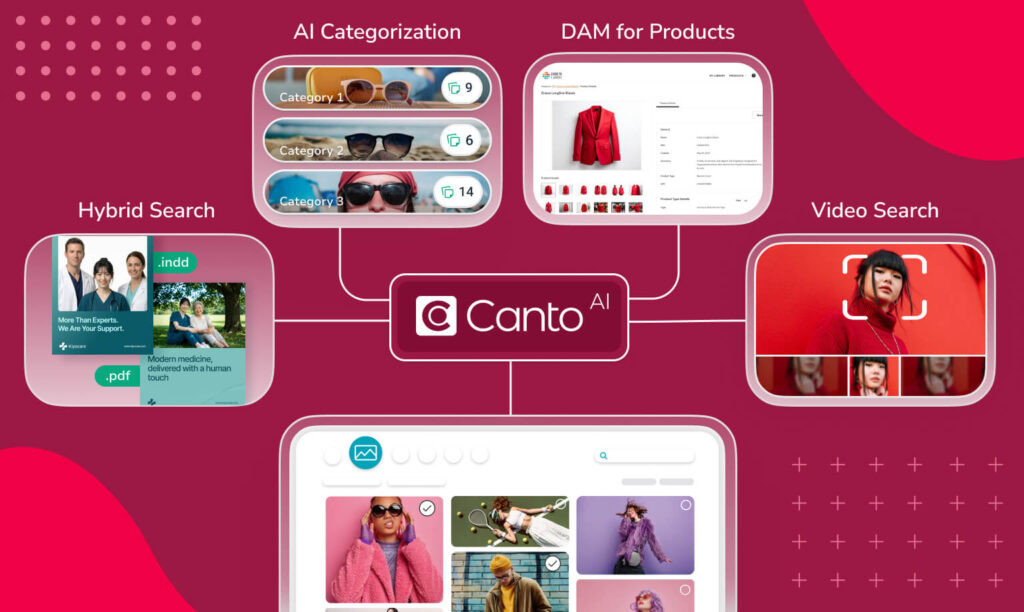
Canto is the original DAM pioneer, with 30+ years of DAM expertise and 4,000+ brands worldwide. As a DAM-first company, Canto’s industry-leading, AI-powered platform is purpose-built for digital asset management at scale — combining AI-powered search, unlimited Portals, built-in workflow approvals and templating, DAM for Products, and dedicated implementation support. Unlike marketing platforms that bolt DAM onto a broader suite, Canto delivers the depth enterprise teams need in an intuitive experience any skill level can adopt.
Who is Brandfolder?
Brandfolder is a DAM platform built around a flat tagging structure and analytics-forward interface. Originally founded in 2012, Brandfolder was acquired by Smartsheet in 2021. As Smartsheet has evolved its focus toward project and portfolio management, Brandfolder has increasingly been managed and sold through Smartsheet’s broader sales and support organization. This shift reshaped the product’s support model and development trajectory, stalling product innovation. For organizations making a multi-year platform investment, vendor trajectory is worth weighing alongside feature sets.
What are the key differences between Canto vs. Brandfolder?
- Vendor stability and DAM expertise. Canto is a DAM-first company with 30+ years of dedicated investment in the category. Brandfolder operates under Smartsheet, whose primary focus is PPM (not DAM) which has affected Brandfolder’s product roadmap, support staffing, and long-term direction. Canto customers get dedicated account managers and DAM-specialist implementation support, while Brandfolder accounts receive Smartsheet generalists or, at lowest tiers, only email support.
- Faster time to value. Canto customers go live in an average of 2.3 months (compared to 2.6 months for Brandfolder) and see ROI in 12 months on average versus Brandfolder’s 16 months (G2 Fall 2026 DAM Grid Report). Canto’s transparent, flat pricing with unlimited users and portals included means no surprise add-on costs eating into that return.
- Stronger search capabilities. Canto outperforms Brandfolder on G2’s search satisfaction rating (88% vs. 85%), with AI Visual Search spanning images and video, facial recognition, and hybrid search, all in a single, unified experience. Brandfolder has no video AI search capability.
G2 ratings comparison — Fall 2026
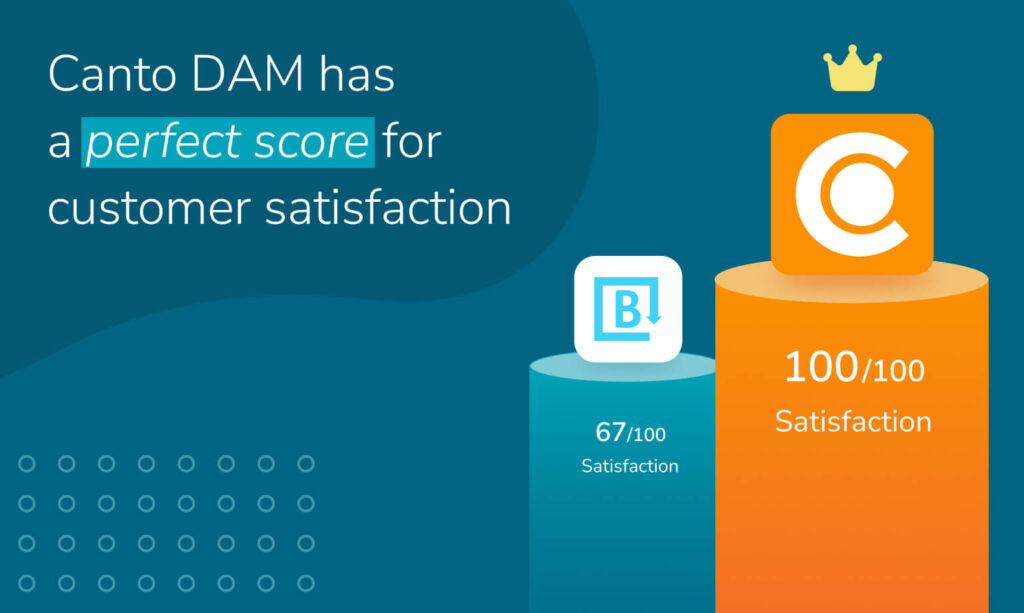
Canto is the most popular DAM platform on G2, with 1,693 reviews and a perfect Satisfaction score of 100, compared to Brandfolder’s 1,339 reviews and Satisfaction score of 67. Canto’s overall G2 score is 91 versus Brandfolder’s 74.
Across the specific metrics most relevant to DAM buyers, Canto outperforms Brandfolder in several key areas:
| G2 metric | Canto | Brandfolder |
|---|---|---|
| G2 Score | 91 | 70 |
| Satisfaction | 100 | 61 |
| Product Going Right Direction | 91% | 85% |
| # of Reviews | 1,730 | 1,342 |
| Ease of Doing Business With | 93% | 89% |
| Quality of Support | 92% | 90% |
| Estimated ROI | ~12 months | ~16 months |
| Ease of Admin | 89% | 87% |
Canto vs. Brandfolder feature comparison
The table below compares Canto vs. Brandfolder across the categories most relevant to DAM buyers evaluating mid-market solutions.
| Feature | Canto | Brandfolder |
|---|---|---|
| Search | AI Visual Search across images and video; hybrid search; facial recognition built in | AI-powered search is powered through automatic tagging (Brandfolder) |
| Asset organization | Folders, AI-assisted metadata based on existing taxonomy, AI-assisted categorization for new uploads at scale, and Smart Tags | Flat tagging system only; no folder structure |
| DAM for Products | Built-in; no third-party integration needed | No native product information capability |
| Brand management | Unlimited Portals included in core plan | Enterprise package is suggested to manage several independent teams, brands, or customers within Brandfolder |
| Digital Rights Management | Included in core platform; expiration dates, download controls, watermarking | Available but requires additional configuration and cost |
| Workflow & approvals | Built-in approvals, annotations, versioning | Available but configuration-heavy |
| Analytics & reporting | Built-in usage insights for all customers | Advanced analytics tied to higher-tier plans |
| Implementation time | 2.3 months average; led by dedicated, Canto DAM specialists | 2.6 months average; increasingly handled by Smartsheet generalist teams |
| Customer resources | Canto Academy: tactical tutorials on DAM features and overall DAM strategy from Canto DAM experts | Basic how-to resources and non-DAM-specific tutorials from Smartsheet University |
| Customer support | Dedicated AMs and tailored implementation support for every account | Email-only support for lowest tier accounts; no dedicated CSM |
| Pricing model | Transparent, flat — unlimited users and portals | Add-on fees for portals, templating, storage, and metadata exports |
| Security & permissions | Granular role-based access control (RBAC) at folder, album, and asset level; single sign-on (SSO), multi-factor authentication (MFA), audit logging | Single sign-on (SSO), role-based access control (RBAC); permission management becomes complex at scale without dedicated admin resources |
| Vendor focus | Independent, DAM-first company with 30+ years in the category | Subsidiary of Smartsheet; primary focus is PPM |
Fast to launch, faster to pay off
One of the most overlooked metrics in any DAM evaluation is whether teams actually adopt the platform after it goes live. A system with every feature on the checklist delivers nothing if it sits unused, and the data shows a meaningful gap between Canto and Brandfolder here.
G2’s Fall 2026 data shows Canto’s average implementation time is 2.3 months, compared to Brandfolder’s 2.6 months. More significantly, Canto customers recover their investment in 12 months on average compared to 16 months for Brandfolder. That four-month gap in time to ROI represents real quarters where Canto earns its keep while Brandfolder is still ramping up.
Canto
Canto’s folder structure, clean interface, and guided onboarding (led by experienced DAM specialists, not generalist Smartsheet reps) mean teams are productive from day one without the weeks of configuration. Every Canto customer receives a dedicated account manager and access to implementation support regardless of contract size . The consistency Canto brings to the table (92% quality of support on G2) matters when you’re deciding which platform to build the foundation of your content operations on. The result is a platform teams reach for rather than work around.
Brandfolder
Brandfolder’s flat tagging structure and configuration-heavy setup require more upfront investment from the teams deploying it. Lowest tier accounts receive email-only support without a dedicated CSM, meaning the teams most in need of onboarding guidance are the least likely to get it. Implementation is increasingly handled by Smartsheet’s generalist teams, who bring project management expertise rather than DAM specialization.
Bottom line: Time to value is the most honest measure of a DAM investment. Faster implementation, faster ROI, and dedicated specialist support at every account size mean Canto is built to deliver value before Brandfolder customers finish configuring their setup.
AI that works the way you think and gets sharper over time
There’s a significant gap between Brandfolder and Canto when it comes to AI capabilities. Brandfolder only offers basic smart tagging. Canto offers AI Visual Search, facial recognition, video search, and AI Library Assistant, which learns your taxonomy over time. And you’ll feel this AI capabilities gap more and more as you scale your library.
Search your whole library, not just tagged images
Canto AI Visual Search represents a fundamental investment in what DAM search can and should be. Visual recognition, natural language queries, and your organization’s own metadata work together in a single experience, spanning images and video. For video, that means object detection, facial recognition, and audio transcription that lets users jump directly to the relevant timestamp inside a clip, not just locate the file.
Brandfolder hasn’t made the same kind of investment in AI-powered search. Brandfolder’s search is built around its flat tagging structure. Brandfolder’s “Video AI” capabilities are included in the “Premium” package (Brandfolder) and rely on auto-tags and transcription. Video search means transcript keywords and generic tags, nothing more.
For teams searching a shared library dozens of times a day, that gap is felt constantly. For teams with growing video libraries, that’s not a gap in one feature. It’s a gap in the platform’s entire approach to AI.
AI that learns how your team thinks and organizes
Canto AI Library Assistant learns an organization’s taxonomy and metadata structure over time, analyzing existing tags to understand how a specific team organizes its content. As it ingests new assets, it recommends organization-specific tags drawn from that learned taxonomy, so metadata stays consistent with established conventions rather than drifting into inconsistency.
Brandfolder’s generic AI tags assets in isolation, without reference to your organization’s structure. At low volumes, that’s fine. At scale, it means metadata inconsistency compounds quietly until assets stop surfacing and teams start re-creating work that already exists.
The bottom line on AI
Canto AI finds what’s already in your library easily and keeps new assets consistent enough to find later without the usual manual lift. Canto’s 2026 State of Digital Content Report found that teams with mature, AI-supported workflows are twice as likely to see significant gains as those using AI in more fragmented ways (44% vs. 19%). Brandfolder can tag a new asset, but it can’t search without metadata or learn that your team calls that asset a “hero shot” rather than “product image.”
Those gaps are small on day one. By the time your library hits scale, they’re the reason your team saves time with Canto, or the reason work gets duplicated with Brandfolder.
One intuitive system for your assets and product data
When product data and the assets that represent it live in separate systems, every launch, refresh, and regional variant requires a synchronization step that someone has to own (and that someone is usually stretched thin already). For SKU-heavy businesses, the right DAM makes sure product data and product content move as one.
Canto
Canto DAM for Products combines asset management and product data in a single platform; no separate product information management system, no third-party integration, and no syncing logic to break. Marketing and product teams work from the same source of truth, and finalized content can be pushed directly to storefronts, marketplaces, and partners without the handoff overhead that separate systems create. Even better, Canto’s Amazon and Shopify integrations simplify product distribution and syndication, saving teams tons of time.
Brandfolder
Brandfolder has no native product information management capability. It’s a DAM and only a DAM. Organizations that need to connect product data to their digital assets have to build and maintain that bridge themselves, typically through a third-party integration with a separate platform. That integration becomes a dependency and an expenditure: one more system to license, one more sync to monitor, and one more point of failure on every product launch.
Bottom line: New Canto research suggests 78% of product-driven businesses are managing product content across two or more separate solutions (and only 38% using a centralized product information approach). Teams with full digital asset and product content connectivity are 4x more likely to see significant content ROI improvement (56% vs. 13%).
The math isn’t complicated: fewer systems means fewer handoffs, faster launches, and less time spent keeping two platforms in sync. Canto eliminates two-system overhead, giving teams one source of truth for both the asset and the product information it represents (and the ROI that comes with it).
A complete brand governance suite
Brand management is increasingly central to the DAM buying decision, and a platform that gates governance tools behind add-on fees or complex configuration is a platform where brand standards erode in practice, even when they’re documented in theory.
Canto
Canto is built for end-to-end brand management, combining the governance infrastructure and creative execution tools teams need to protect and scale their brand. Every plan includes unlimited Portals and unlimited end users with granular access controls, Digital Rights Management, approval workflows, asset expiration dates, and analytics from the foundation. That means, adoption and enforcement of brand standards are limitless. Brand Studio extends those capabilities for on-brand content creation and localization with AI-powered templates. Approval Hub centralizes proofing and version tracking for complex review cycles, and Media Publisher automates delivery to storefronts, websites, and distribution platforms. Together, these capabilities form a connected brand management system where governance, content production, and distribution work from the same source of truth.
Brandfolder
Brandfolder includes brand portals (but only for enterprise and higher-tiered plans) and core governance controls in its DAM, but the suite is narrower and more expensive to build out. Advanced analytics and deeper governance capabilities are available as add-ons. For example, templating, a crucial tool for brand consistency, is an expensive (and unreliable) add-on. The further your brand management needs extend beyond Brandfolder’s core feature set, the more the cost compounds.
Bottom line: G2 reviewers rate Canto higher than Brandfolder on brand guidelines (87% vs. 86%), Digital Rights Management (88% vs. 85%), and analytics (80% vs. 78%). Those gaps reflect a real difference in brand governance capability depth. Canto’s brand management capabilities are more comprehensive, more connected, and don’t require a separate conversation every time your needs expand.
The price you’re quoted vs. the price you’ll pay
Comparing DAM pricing requires looking beyond the headline contract value to account for the fees that compound over time. Beyond the base license, total cost of ownership includes implementation, third-party connector licensing, usage-based variables, and any add-ons required to access features that should come standard.
Canto
Canto is designed to give teams the platform they need out of the box without the hidden cost. Unlimited end users and unlimited Portals are included in the core plan. Canto AI is embedded directly into the platform where teams work, not dependent on tiers. For teams that want to go further, Canto offers add-ons across the content lifecycle. including Brand Studio, Approval Hub, and Media Publisher. Implementation is led by Canto DAM specialists who scope it transparently upfront, and the results bear that out: 2.3 months to go live and ROI in 12. The price you’re quoted is the price you plan around, and the results show up faster than the alternative.
Additionally, Canto comes with Canto Academy access, providing customers with self-serve resources from their DAM experts to learn more about their DAM and finetune their DAM strategy. Compared to Brandfolder’s basic how-to resources and non-DAM-specific Smartsheet University, Canto Academy is the kind of strategic resource that maximizes DAM investment.
Brandfolder
Brandfolder’s pricing model includes a range of add-on fees that make total cost of ownership difficult to forecast. Storage, portals, templating, and metadata exports have all been cited as separate charges. Without any real AI innovation, those additional costs are hard to justify. Smartsheet’s shift toward monetizing collaborator seats across its own platform has also raised concerns about future licensing changes for Brandfolder customers. For organizations planning a multi-year investment, that kind of structural uncertainty is worth factoring into the evaluation.
Bottom line: Brandfolder’s add-on structure means the platform you evaluated and the platform you’re running six months later can look very different on a budget spreadsheet. Storage caps, portal fees, metadata export charges; each one is a line item that wasn’t in the original conversation or contract. Canto’s inclusive pricing model means the scope of what you’re buying is clear from the start, and scaling the platform doesn’t require renegotiating.
Security your marketing team can own
Both Canto and Brandfolder meet enterprise-grade security requirements across the most common procurement evaluation criteria. The meaningful difference between them is not in certifications; it is who manages the system day-to-day, and how much IT involvement that requires.
Canto
Canto’s permission model gives marketing and operations teams the controls they need without requiring IT to run the platform. Role-based access control works at the folder, album, and individual asset level, including watermarking, download restrictions, and guest access management. SAML 2.0 SSO integrates with Okta, Azure AD, and other major identity providers. MFA, audit logging, and 24/7 platform monitoring are standard. In short, the people who own the content own the access model, and IT can support as needed without needing to support constantly.
Brandfolder
Brandfolder’s security feature set is comparable; SSO, RBAC, encryption at rest and in transit, and audit logging are all available. Granular permission management at scale, however, becomes more difficult to maintain without dedicated administrative resources, particularly given Brandfolder’s flat structure, where access controls must be managed at the tag or collection level rather than through a folder hierarchy.
Bottom line: Security reviews that require IT involvement slow procurement, and ongoing IT dependency means every access change, new team onboarding, or permission update becomes a ticket in someone else’s queue. Canto is built to pass enterprise security reviews and be managed day-to-day by the marketing or operations teams who own the system, giving IT confidence without creating an IT dependency.
A vendor committed to getting DAM right
For organizations making a multi-year platform investment, vendor stability is central to how much value the platform delivers over time.
Canto
Canto has over 30 years of focused investment in digital asset management, from launching one of the first DAM solutions to advancing AI across the content lifecycle, and unifying digital assets and product content with DAM for Products. With a dedicated product roadmap, leadership team, and support organization built exclusively around DAM and innovating in the DAM space, Canto’s direction is not subject to the shifting priorities of a parent company with a separate core product.
Brandfolder
Since Smartsheet’s acquisition in 2021, Brandfolder has operated as a subsidiary within an organization whose primary focus is project and portfolio management. Reporting indicates that Brandfolder’s implementation and account management have shifted toward Smartsheet’s generalist teams, as reflected in LinkedIn data and G2 reviews. G2 reviewers rate Brandfolder’s “Product Going Right Direction” at 85% compared to Canto’s 91%. This gap reflects customer-level awareness of which platform is heading down the stronger path.
Bottom line: Brandfolder falls short on feature parity and doesn’t guarantee investment value tomorrow. When evaluating a long-term platform partner, it’s worth asking: is DAM their priority, or a product line they inherited? A vendor that has deprioritized its DAM team, shifted onboarding to generalists, and is navigating its own ownership changes is a vendor whose roadmap is harder to trust. Canto has spent 30 years building DAM and nothing else. That focus is the product, and it shows up in every customer interaction, every implementation, and every release.
Why brands choose Canto vs. Brandfolder
Choosing the right DAM platform is ultimately a decision about what your team can realistically adopt, scale, and get lasting value from. Canto is built around that reality.
With a G2 score of 91 (compared to Brandfolder’s 74) and the most DAM reviews on G2, Canto is the most evaluated and most highly recommended platform, earning a coveted spot on G2’s Best of 2026 list (unlike Brandfolder). Faster implementation (2.3 months average vs 2.6), faster ROI (12 months versus 16), AI search that spans your entire library, including video, transparent pricing with unlimited users and portals, and dedicated DAM-specialist support for every account; all from a company that has been building DAM software longer than any other leading DAM solution.
For teams evaluating Brandfolder alternatives, the choice ultimately comes down to this: a platform managed within a PPM company’s broader priorities, or a DAM built by a company that has never done anything else. Canto delivers the stronger DAM platform without the add-on fees, the generalist support model, or the uncertainty of a product being deprioritized within a larger organization’s roadmap. And that’s a foundation worth building on.
Frequently asked questions
Is Canto a good alternative to Brandfolder?
Yes. Canto is the most frequently evaluated Brandfolder alternative on G2, with a G2 score of 91 compared to Brandfolder’s 74 and a perfect Satisfaction score of 100. Canto offers faster implementation (2.3 months average vs. 2.6), faster ROI (12 months vs. 16), dedicated DAM-specialist support for every account, and transparent pricing with unlimited users and portals included (without the add-on fees that make Brandfolder’s total cost of ownership difficult to forecast).
What are the main differences between Canto and Brandfolder?
The four most significant differences are vendor focus, support model, search, and pricing. Canto is a DAM company with 30+ years in the category; Brandfolder is a Smartsheet subsidiary whose core business is project management software. Canto includes unlimited users, portals, and AI in its base plan; Brandfolder charges separately for each. And where Canto AI Visual Search spans images and video in a single unified experience, Brandfolder lacks video AI search.
How does Canto compare to Brandfolder on G2?
Canto outperforms Brandfolder across the metrics that matter most to DAM buyers. Canto’s overall G2 score is 91 versus Brandfolder’s 74, with a Satisfaction score of 100 compared to Brandfolder’s 67. Canto also leads on Ease of Admin (89% vs. 87%), Quality of Support (92% vs. 90%), Ease of Doing Business With (93% vs. 89%), and Product Going in Right Direction (91% vs. 85%). Time to ROI is 12 months for Canto vs. 16 months for Brandfolder. Source: G2 Fall 2026 Grid Report for Digital Asset Management.
Why are teams switching from Brandfolder to Canto?
The most commonly cited reasons are declining support quality, difficulty with Brandfolder’s flat tagging structure and lack of folder navigation, unpredictable pricing driven by add-on fees, and concerns about Brandfolder’s long-term roadmap under Smartsheet’s ownership. Teams that have switched to Canto have cited better search and AI tagging, faster onboarding led by DAM specialists, and a more intuitive interface that drives higher user adoption across the organization.
Does Brandfolder have a product information management solution?
No. Brandfolder is a DAM-only platform with no native product information management capability. Organizations that need to connect product data to their digital assets must implement and maintain a separate platform and third-party integration. Canto offers built-in DAM for Products, combining asset management and product data in a single platform with no third-party integration required.
What is Brandfolder’s relationship to Smartsheet?
Brandfolder was acquired by Smartsheet in 2021. Smartsheet was subsequently acquired by Blackstone and Vista Equity Partners. Brandfolder now operates as a product within Smartsheet’s portfolio, whose primary focus is project and portfolio management software. This has resulted in Brandfolder’s sales, implementation, and account management functions increasingly being handled by Smartsheet’s generalist teams rather than DAM specialists.
