Canto vs. Frontify
Canto is an AI-powered DAM built to scale brand management across channels, approvals, and products, with faster implementation and stronger adoption driving nearly 2x faster ROI than Frontify on G2.

Purpose-built digital asset management versus a brand management suite; how Canto and Frontify compare across AI capabilities, asset organization, pricing transparency, and the features that matter most to marketing and creative operations teams.
Canto and Frontify often appear in the same DAM evaluation, but they were built for different purposes. Frontify is a brand management platform with digital asset storage tacked on. Canto is a purpose-built DAM for brand management, designed to centralize, find, and activate content at scale across the full marketing and creative operations workflow. It’s the depth of robust DAM capabilities, advanced search, AI capabilities, and predictable pricing that define which one is the right fit.
Who is Canto?
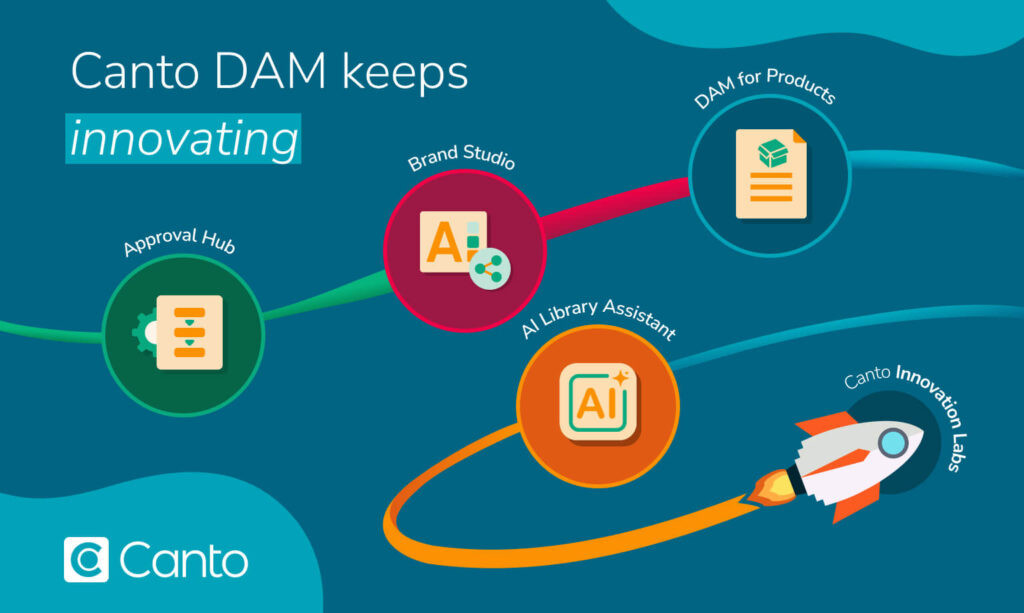
Canto is the original DAM pioneer, with 30+ years of DAM expertise and 4,000+ brands worldwide. Its AI-powered platform is purpose-built for brand management, creative operations, and marketing efficiency — centralizing, organizing, protecting, and distributing digital assets with AI-powered search, unlimited Portals, workflow approvals, and DAM for Products. Canto helps teams find the right asset in seconds, move it through approvals efficiently, and deliver it to the right people and channels with the right permissions in place.
Who is Frontify?
Frontify is a brand management platform that combines brand guidelines, creative templates, and digital asset storage in a single environment. Its primary audience is brand managers and design leads focused on governing how a brand is expressed and distributed across an organization. DAM is a feature within Frontify’s platform, not its core purpose.
What are the key differences between Canto and Frontify?
The core distinction comes down to what each platform was fundamentally built to do. Canto is a leading DAM with proven AI capabilities, brand management tools, Product Hub built-in, and distribution integrations. Frontify is a brand management platform that has evolved to include asset management capabilities.
In practice, that distinction shows up in three critical areas:
- AI search depth. Canto AI Visual Search is proven and production-ready, with hybrid search (both visual search and metadata search simultaneously) that works across images, video, and multiple file types. Frontify’s AI search is less mature. Canto’s AI search was released in 2024, while Frontify’s Enhanced Image Search remains in Open Beta as of August 2026 and is primarily focused on image assets.
- Library architecture. Canto enables unified organization and search across your entire asset library, all file types. Frontify’s library is organized per Brand, with no cross-Brand search capability (Frontify). For large, multi-brand organizations, this creates access and retrieval friction.
- Product-focused capabilities. Canto DAM for Products connects asset management and product data natively. Frontify has no native product management capabilities and relies on integrations with PIM solutions.
G2 ratings comparison, Fall 2026
Canto is the most popular DAM platform on G2. According to reported metrics in G2’s Fall 2026 Grid Report for Digital Asset Management, Canto outranks Frontify for overall G2 Score, Satisfaction, Market Presence, Implementation Time, Average User Adoption, and Estimated ROI, cementing its position as the go-to turnkey DAM solution for streamlined brand management.
| G2 metric | Canto | Frontify |
|---|---|---|
| G2 Score | 91 | 51 |
| Market Presence | 82 | 68 |
| Satisfaction | 100 | 34 |
| Implementation Time | 2.3 months | 3.6 months |
| Average User Adoption | ~59% | ~50% |
| Estimated ROI | ~12 months | ~22 months |
Canto vs. Frontify feature comparison
The table below compares Canto vs. Frontify across the categories most relevant to buyers evaluating brand management and digital asset management solutions.
| Feature | Canto | Frontify |
|---|---|---|
| User interface & ease of use | Intuitive, clean interface; fast adoption, minimal training required | Front-end UI optimized for brand portal browsing; complex back-end UI for true DAM administration |
| Asset organization | Folders, AI-assisted metadata based on existing taxonomy, AI auto-tagging, and Smart Tags | Brand-siloed library structure; organized per Brand with no cross-Brand search |
| AI video search & transcription | Proven visual search across images, video, RAW, and all file types; video jump-to-timestamp; AI transcription built in | Nascent, in-beta visual search limited to PNG, JPEG, WEBP, limited to metadata and descriptions; no video search; requires third-party tools for transcription |
| Metadata & taxonomy | Deep metadata schemas, custom fields, AI auto-tagging, face & text recognition | More limited metadata depth; primarily manual tagging workflows |
| DAM for Products | Native product capabilities; asset-to-product mapping built in | No native product management capabilities; requires integration into PIM systems |
| Approval workflows | Approval Hub with structured, multi-stage, linear review flows | Limited structured approval depth |
| Brand guidelines | Interactive, fully searchable destination for approved assets, usage rules, and brand standards; deployable in unlimited Portals | Interactive brand guidelines with embedded design tokens, component libraries, and AI Brand Assistant |
| Brand portals | Unlimited branded portals are included on all plans | Brand portal tools and design system support |
| Rights Management | Digital Rights Management with expiry dates, usage rights, licensing fields, and watermarking | Limited rights management capabilities |
| Usage analytics | Usage reporting, link tracking, portal analytics across all assets | Brand-focused analytics; fewer asset consumption insights |
| Integrations | 90% native integrations: Adobe CC, Workfront, Slack, Salesforce, RESTful API | 65+ integrations; some of which require 3rd party support and/or add-on charges |
| User licensing | Unlimited end users are included on all plans | Average MAU-based; all users, including external partners, count toward the monthly total |
| Implementation time | 2.3 months average | 3.6 months average |
| Pricing model | Transparent, flat pricing | Variable charge by user and brand; unpredictable as end users scale (Frontify) |
| Onboarding | Dedicated onboarding team; structured go-live process | Self-service with documentation and guided setup (Frontify) |
| Security & SSO | SOC 2 Type II, ISO 27001, GDPR, SAML 2.0 SSO, Okta, Azure AD | SOC 2, GDPR, HIPAA, SSO, role-based access |
One tool for total brand governance and streamlined content operations
Canto and Frontify are built around fundamentally different assumptions about what a content team needs. Canto is an AI-powered DAM built for brand governance, end-to-end content operations, and product distribution; Frontify is a brand management platform with asset storage as a feature. That distinction shapes every product decision for these platforms: one platform gets your content to storefronts, social channels, and markets at scale while enforcing your brand; the other helps you govern how your brand looks and gives you a place to store assets, but falls short on streamlining the entirety of your content operations.
Canto
Canto is a purpose-built digital asset management platform, and that focus shapes every product decision. Canto is designed from the ground up for the workflows marketing and creative operations teams depend on daily, like:
- Finding assets fast across large libraries
- Running structured approval workflows
- Managing digital rights
- Distributing content to the right people, partners, and channels with the right permissions in place
Over 30 years of DAM-focused innovation means no compromises on the capabilities that matter most, including:
- AI Visual Search across images and video (including RAW files),
- DAM for Products linking assets directly to product information
- Approval Hub for structured content review
- Brand Studio for on-brand creative production
- Native integrations with Shopify and Amazon
- Media Publisher to deliver approved assets directly to storefronts, websites, and social channels.
Canto also includes unlimited Portals, unlimited Style Guides, unlimited user seats, and Digital Rights Management out of the box, not charged by brand or adoption. With Canto, you get a single platform for brand management that keeps your brand consistent, your content moving, and your operations running at scale.
Frontify
Frontify is a brand management platform that brings brand guidelines, creative templates, and digital asset storage together in one environment, designed for brand and design teams whose primary challenge is brand governance: ensuring visual consistency, distributing brand standards, and giving teams a single source of truth. While those priorities are strengths for pure brand governance work, they create compounding constraints for overall content operations, such as:
- Asset libraries are organized per Brand with no cross-library search
- AI search in beta, with limited metadata depth
- PIM capabilities don’t exist
- Limited native media delivery automation or channel distribution capability for teams scaling content across storefronts, websites, and social platforms.
Bottom line: Most teams evaluating Canto and Frontify have already outgrown a brand portal or a shared drive. If your challenge is narrowly about brand governance, communicating visual standards to internal teams and agencies, a brand management platform might suffice. But if your challenge is both brand management and managing and activating content at scale, a purpose-built DAM is the best answer. For teams managing large asset volumes, multiple file types, including video, complex metadata, cross-team workflows, and looking for real AI search capability, the platform of choice is Canto.
Brand management built around your products and your guidelines
Organizations that manage product imagery, specs, packaging files, and SKU-level content need more than organized brand guidelines; they need a platform built around the product as the organizing unit. For product-driven brands scaling across regions, channels, and retail partners, the difference between a DAM with native product capability and a brand portal without it shows up in launch delays, coordination overhead, and fragmented storefronts.
Canto: One source of truth for assets and product data
Canto DAM for Products combines asset management and product data in a single powerful platform; no separate product information solution, no third-party integration, no syncing overhead. Teams can organize product data around creative assets and push finalized content and product details to storefronts, partners, and marketplaces from one source of truth. Even better, Canto’s Amazon and Shopify integrations simplify product distribution and syndication, saving teams tons of time.
Every new SKU, product refresh, or regional launch creates a coordination challenge when product data and brand imagery live in separate systems. Canto eliminates that overhead, giving teams one place to manage both the asset and the product information it represents. New Canto research reinforces the cost of fragmentation: 78% of product-driven businesses are using two or more separate solutions to manage product content, and teams with full digital asset and product content connectivity are 4x more likely to see significant content ROI improvement.
Frontify: No native product data capability
Frontify has no native product information management capability and is not built for product-centric organizations. While Frontify offers a PIM integration with Akeneo, these require a separate platform to manage product information; they don’t compete with the ease and benefits of native product data management. For teams managing SKU-level content, product packaging, or regional launches, relying on separate systems and manual coordination to keep product data and assets aligned means more manual lift, more opportunity for error, and less ROI on their tech investment.
Frontify’s brand-siloed library structure compounds the problem. Assets are organized per Brand with no cross-Brand search, so product content for different brands, regions, or product lines lives in disconnected libraries. For organizations with multiple brands or complex go-to-market operations, that architecture means no unified view of product assets across the catalog.
Bottom line: For teams that manage and sell products, Canto’s native product asset management is a structural advantage that a brand governance platform cannot replicate. One platform connecting your asset library to your product data means faster launches, more consistent storefronts, and no overhead from keeping two systems in sync.
AI-powered search and asset organization: Where value is won or lost
The ability to find the right asset quickly is the single most important capability in any DAM evaluation. Here’s how Canto’s proven AI-powered hybrid search and deep metadata capabilities compare to Frontify’s brand-siloed, tag-reliant library structure, and what the difference means for teams managing real content at scale.
How Canto organizes and surfaces assets at scale
Canto is built to handle asset libraries of genuine scale, thousands of files across dozens of asset types, with the organizational depth and metadata richness to keep them findable as volume grows. Canto AI Visual Search gives teams a unified way to scan their entire library for visual context, such as objects, people, moods, and scenery in photos and videos, while simultaneously searching metadata fields like keywords, tags, and custom fields across all file types. Teams can upload hundreds of assets and find them immediately, without a dedicated tagging administrator making the library functional first.
Metadata schemas are fully customizable to your organization’s needs, and Canto AI Library Assistant significantly reduces the ingestion workload for brand and creative teams through AI-assisted metadata and automated asset categorization. New uploads are tagged and organized with minimal manual intervention, and AI Library Assistant learns your taxonomy over time, so it gets smarter as your library grows. Because Canto AI Visual Search doesn’t rely on tags to function, assets become discoverable the moment they arrive in the library. For video-heavy teams, native in-video search lets users jump directly to the relevant timestamp inside a clip, with AI transcription built in and no third-party tools required.
How Frontify approaches asset organization
Frontify’s library is organized by Brand, a clean structure for brand-governed asset distribution, but one that creates a meaningful constraint: search is scoped per Brand, with no cross-Brand search capability, making the back end very difficult to manage due to the meticulous governance and complicated user access permissions required. For organizations managing multiple product lines, markets, or content types within a single environment, this limitation creates friction that compounds as the library grows. Metadata capabilities are more limited, with search relying more heavily on manually applied tags and descriptions. Frontify’s AI-powered search is a late-to-the-game addition and is limited to PNG, JPEG, and WEBP files; an overall reflection of Frontify’s lagging investment in the kind of AI capabilities defining the future of DAM. Video search and AI transcription are not supported natively.
Bottom line: For teams managing growing content libraries, findability is the difference between an asset library that pays for itself and one that generates daily frustration. Poor search means teams recreate assets that already exist, use outdated versions, and spend time hunting instead of creating. The metadata depth and AI capabilities that make a large library usable are the foundation of DAM ROI, not optional features.
Up and running fast: How quickly can your team actually get to work?
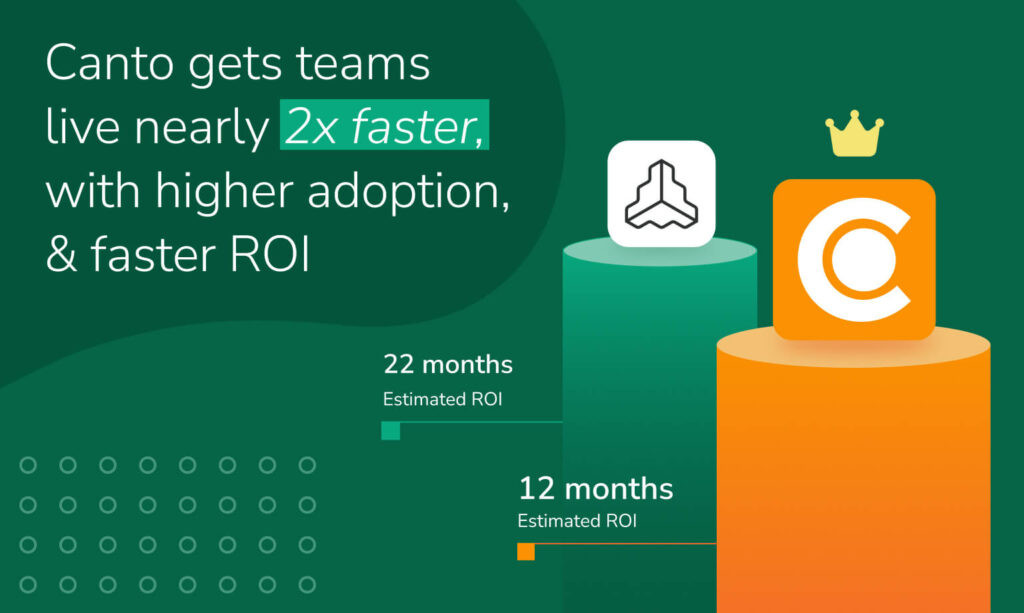
Time-to-value is a financial metric, not just an operational one. Every week before go-live is a week of unrealized ROI, and every team member who doesn’t adopt the platform is a seat you’re paying for without return. G2 Fall 2026 data shows Canto gets teams live faster, with higher adoption, and reaches ROI nearly twice as quickly as Frontify.
Canto
Canto provides a dedicated onboarding team of Canto DAM specialists with a structured go-live process, so teams aren’t left to configure the platform independently. G2 Fall 2026 data puts Canto’s average implementation time at 2.3 months versus Frontify’s 3.6 months, user adoption at approximately 59% versus Frontify’s 50%, and estimated ROI at 12 months versus Frontify’s 22 months. These aren’t marginal differences; they reflect a platform built to get teams productive quickly, not after a drawn-out configuration project.
Canto’s interface is built for the people who work with assets every day, not just the administrators who configure the system. Clean thumbnails, customizable views, and AI-powered search mean teams get productive quickly with minimal training. Reviewers consistently highlight how accessible the platform is for non-technical users, and Canto’s support model carries through long past go-live: responsive, global, and rated by customers as one of the best in the category across four-plus years of platform stability.
Frontify
Frontify’s onboarding is largely self-directed, with documentation and guided setup available but without dedicated hands-on support. G2 Fall 2026 data puts Frontify’s average implementation time at 3.6 months, 57% longer than Canto, with an average user adoption rate of approximately 50% and estimated ROI at 22 months.
Bottom line: Implementation time and user adoption are essential financial and operational metrics. Canto’s guided onboarding and intuitive interface close both gaps significantly, and the difference shows clearly in G2’s comparative data: 2.3 months to go live versus 3.6, 59% user adoption versus 50%, and ROI reached in 12 months versus 22.
Your DAM should work with your stack, not create more manual work
A DAM lives inside a larger content workflow. The depth and reliability of its integrations determine whether it removes friction or adds steps. Canto’s 90% native integration ecosystem covers the tools marketing, creative, and product teams depend on daily; Frontify’s integration set is designed primarily around brand governance and creative distribution.
How Canto connects to the tools your team already uses
Canto’s integration ecosystem spans the tools that marketing, creative, and content operations teams rely on daily. For creative teams, Canto integrates natively with Adobe Photoshop, Illustrator, InDesign, and Premiere Pro, so designers can access and use approved assets without leaving their creative environment. That keeps approved content flowing into active workflows and eliminates the friction of hunting across systems during production.
Beyond Adobe, Canto’s native integrations cover the core marketing tech stack: Office 365, Salesforce, Slack, Figma, Shopify, Amazon, and more, extending your content workflow directly into distribution. For technical buyers who need flexibility beyond pre-built connectors, Canto provides robust API access for building custom integrations with proprietary systems, including product catalog systems, distribution channels, and other workflows that require tailored integration work. Canto’s integration library is built around native connectors for more reliable, stable connections across your content workflow.
Frontify’s integration approach
Frontify offers integrations with Canva, Salesforce, Figma, and Sketch, a focused set designed around brand governance and creative distribution workflows. For teams whose content operations extend into deeper project management, product systems, or custom distribution channels, Frontify’s integration set is more constrained.
Bottom line: When evaluating integrations, it’s worth asking not just what’s on the list, but whether connections are native or connector-dependent. Native integrations mean less maintenance, fewer sync failures, and more reliable asset flow. Canto’s 90% native integration rate is a meaningful operational advantage for teams with complex tech stacks.
No surprises, no hidden bills: What predictable DAM pricing actually looks like
DAM pricing is rarely as simple as the headline contract value. MAU-based models (Monthly Active Users), usage spikes, and add-on fees can drive total cost well beyond initial projections. This section breaks down how Canto and Frontify approach pricing, and what that means for your budget as the team and partner network grow.
Canto’s pricing model
Canto’s pricing is transparent and structured, with unlimited user seats and unlimited portals included in the core plan. There’s no per-seat penalty for adding team members and no surprise charges when external collaborators access a portal. Canto also includes Canto AI, Digital Rights Management, and unlimited Style Guides out of the box. Canto gives your organization everything it needs to manage the entire lifecycle of your digital assets, including comprehensive brand governance, without the pricing peaks that come from volatile MAU pricing. In short, Canto’s predictable pricing means it’s easier to scale adoption and easier to see ROI.
Frontify’s pricing model and what to watch for
Frontify’s pricing model is based on Monthly Active Users (MAU), defined as any user who logs into the platform at least once per month. Critically, that definition includes external partners: agency collaborators, contractors, and third-party stakeholders all count toward your MAU total. The number of brands (and associated brand guidelines and portals) can also increase the price.
For organizations that work regularly with external partners, which describes most marketing and brand teams, this creates a pricing structure that is difficult to predict and manage. Peak periods, such as major product launches, seasonal campaigns, and brand refreshes, can drive costs above baseline as external usage spikes.
Bottom line: G2 Fall 2026 data puts Canto’s estimated time to ROI at approximately 12 months, compared to approximately 22 months for Frontify; a gap that represents a material cost difference over a multi-year contract. Pricing models matter as much as price. A platform that charges based on monthly active users, including external partners, effectively penalizes teams for doing their jobs. Every agency access, every external review, every partner portal visit, and every additional brand adds to the bill in ways that are hard to forecast and harder to justify at budget review. Canto’s unlimited-seat model keeps the math simple as your team and partner network grow. And, with Canto, more adoption means faster ROI and more value.
Enterprise-grade control over who gets access (and to what extent)
Security evaluation in DAM is less about certifications, which most serious platforms hold, and more about access granularity. When comparing DAM security, identify whether the permission model operates at the folder, album, and individual asset levels and is built to be administered by the teams that own it, not just by IT.
Canto
Canto meets enterprise-grade security requirements across the most common procurement criteria. Canto holds SOC 2 Type II and ISO 27001:2022 certifications, with full GDPR compliance and data residency options for international teams. Canto supports SAML 2.0 SSO with native integrations for Okta and Azure Active Directory, meeting the baseline enterprise IT requirement for identity management.
Canto’s permission model supports granular role-based access control at the folder, album, and individual asset levels. Administrator, Collaborator, and Consumer roles give organizations the flexibility to manage internal team access alongside external stakeholder sharing, with watermarking, download restrictions, and expiry controls for all external links. For teams managing sensitive assets, including unreleased product imagery, confidential brand materials, and region-specific content, that level of permission granularity is essential. Canto also supports procurement requirements in healthcare, pharma, and other regulated sectors.
Frontify
Frontify holds SOC 2, GDPR, and HIPAA certifications and supports SSO and role-based access with brand portal segmentation. For organizations whose requirements align with standard enterprise security baselines, Frontify meets common procurement criteria. Its permission model is designed primarily around brand portal access management rather than deep asset-level control.
Bottom line: The differentiating question in security is granularity: can you control access at the folder, album, and asset level? Can you watermark, restrict downloads, and set expiry dates on external links? For organizations managing sensitive or pre-release content, asset-level permission depth is a hard requirement. Canto’s permission model is built for that; and built to be managed by the marketing or operations team that owns it.
Why brands choose Canto vs. Frontify
The choice between Canto and Frontify comes down to what problem you’re actually trying to solve. If your team needs to centralize, find, protect, and activate a growing library of digital assets across images, video, documents, and product content, Canto is purpose-built for exactly that. With proven AI Visual Search that works across every file type, including video, unlimited portals and end users, native product asset management through DAM for Products, structured approval workflows, and deep metadata capabilities that make large libraries genuinely organized, Canto delivers the full content operations platform that a brand management tool can’t replicate.
Transparent, flat pricing means your costs don’t spike every time adoption increases; with an average implementation time of 2.3 months and estimated ROI at 12 months, your team is finding, using, and delivering assets faster than most organizations finish evaluating alternatives. For marketing and creative teams that need a DAM that scales content production and helps deliver and maintain brand consistency across storefronts, websites, social channels, and partner networks, Canto is the clear choice.
