Canto vs. PhotoShelter
Canto delivers AI-powered DAM for every team, every asset type, and every stage of the content lifecycle, delivering faster ROI.

Two DAM platforms compared across AI search, video capabilities, asset lifecycle management, brand governance, and breadth of use.
Canto and PhotoShelter are both established names in digital asset management (DAM), but they are built around fundamentally different assumptions about who a DAM is for. PhotoShelter has roots in photographer and sports media workflows. Canto is built for these audiences as well as a full range of teams managing digital content at scale: marketing, creative, product, operations, and beyond. For organizations evaluating both platforms, it’s important to go beyond feature evaluation and ask which one is built for the way your whole organization works.
Who is Canto?
Canto is the original DAM pioneer, with 30+ years of DAM expertise and 4,000+ brands worldwide. Canto DAM is built for digital asset management at scale, combining AI-powered search, unlimited Portals, built-in approval workflows and templating, DAM for Products, and dedicated implementation support. Unlike platforms built around specific workflows or user types, Canto delivers the depth of support across the full content lifecycle that teams need in an intuitive experience any skill level can adopt.
Who is PhotoShelter?
PhotoShelter is a DAM platform with roots in photographer, sports, and education workflows. Its capabilities are built for media-heavy organizations distributing content to large audiences in real time. For those specific use cases, PhotoShelter is a capable solution. For organizations that need a DAM platform that serves the full content lifecycle across diverse teams and asset types, the platform’s focus becomes a constraint.
What are the key differences between Canto vs. PhotoShelter?
- Broader platform, stronger ROI. Canto is built for the full range of teams managing digital content (not just photographers). G2 reviewers report Canto delivers ROI in 12 months on average versus PhotoShelter’s 21 months (G2 Fall 2026 DAM Grid Report). That nine-month gap reflects a platform that works for more of your organization, more of the time.
- Stronger search. Canto outperforms PhotoShelter on G2’s search satisfaction rating (88% vs. 83%), with Canto AI Visual Search combining visual recognition, natural language queries, and metadata in a single unified experience. PhotoShelter requires users to toggle AI search on and off. With Canto, finding the assets and specific video moments you need is as simple as typing in a quick search.
- The full asset lifecycle, not just storage and distribution. From AI-assisted ingestion and organization to brand governance, approval workflows, templating, and distribution, Canto supports every stage of the content lifecycle. PhotoShelter’s strength is in storage and distribution for specific media workflows; it lacks the robust collaboration, approval, and brand management depth broader teams require.
G2 ratings comparison — Fall 2026
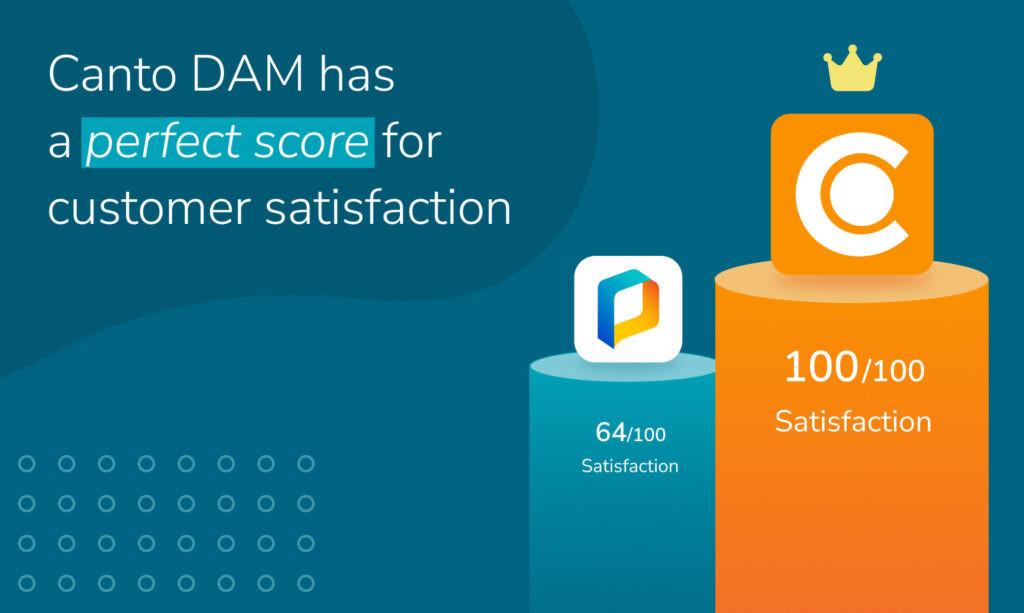
Canto is the most popular DAM platform on G2, with a G2 score of 91, 1,693 reviews, and a perfect Satisfaction score of 100, compared to PhotoShelter’s G2 score of 66, 1,034 reviews, and Satisfaction score of 64.
Across the metrics most relevant to DAM buyers, the gap is consistent and significant:
| G2 metric | Canto | PhotoShelter |
|---|---|---|
| G2 Score | 91 | 68 |
| Satisfaction | 100 | 65 |
| Estimated ROI | ~12 months | ~21 months |
| Product Going Right Direction | 91% | 89% |
| # of Review | 1,730 | 1,045 |
| Ease of Use | 89% | 86% |
| Ease of Admin | 89% | 86% |
Canto vs. PhotoShelter feature comparison
The table below compares Canto vs. PhotoShelter across the categories most relevant to DAM buyers evaluating solutions.
| Feature | Canto | PhotoShelter |
|---|---|---|
| Search | AI Visual Search is fully integrated into a unified search experience, combining AI and metadata without mode switching | Separate AI search workflow rather than a unified search experience; metadata refinement follows the initial search |
| Asset organization | Folders, AI-assisted metadata based on existing taxonomy, AI-assisted categorization for new uploads at scale, and Smart Tags | Folder-based organization; more manual categorization required with some auto-tagging support |
| DAM for Products | Built-in; no third-party integration needed | No native product information capability |
| Brand management | Unlimited Portals and Style Guides included in core plan; comprehensive brand governance suite; AI-powered brand templates for on-brand content creation with Brand Studio, with template volume varying by package | Single portal model for all but Enterprise plan; limited brand customization; limited brand templates in core plan |
| Digital Rights Management | Included in core platform; expiration dates, Terms & Conditions, download controls, watermarking | Digital rights management features available |
| Workflow, approvals & distribution | Built-in approval workflows, annotation, version control in core plan; Multi-step review flows with Approval Hub; automated multi-channel distribution for video and images with Media Publisher | Basic approval statuses; lacks structured enterprise approval workflows; media delivery supported through separate product |
| Real-time ingestion | Direct capture supports real-time secure camera-to-DAM ingestion for photographer workflows | FTP workflows support real-time camera-to-DAM ingestion |
| Analytics & reporting | Built-in usage insights for all customers | Limited asset tracking; no advanced reporting tools |
| Customer resources | Canto Academy: tactical, self-paced tutorials on DAM features and overall DAM strategy from Canto DAM experts | PhotoShelter describes its Academy as “an interactive series of live training sessions” |
| Customer support | Dedicated AMs and tailored implementation support offered for every account, including access to on-demand Canto Academy learning | Standard support; implementation led by scheduled live sessions rather than a dedicated account specialist |
| Pricing model | Transparent, flat; unlimited users and Portals | Tiered pricing; Adobe integrations are add-ons not included in base plans |
| Security & permissions | Granular role-based access control (RBAC) at folder, album, and asset level; single sign-on (SSO), multi-factor authentication (MFA), audit logging | Single sign-on (SSO), sharing permissions, visibility controls; does not offer role-based access control at the asset level |
| Vendor focus | Independent, DAM-first company with 30+ years in the category; built for every team that touches content across industries | Primarily serves photographer, sports, and education workflows; broader use cases are secondary |
Nine months of ROI you shouldn’t have to wait for
The single largest gap between Canto and PhotoShelter in G2’s Fall 2026 data isn’t search or features; it’s time to ROI. Canto customers recover their investment in 12 months on average. PhotoShelter customers wait 21.
That nine-month gap isn’t an abstraction. It’s the difference between a platform that works for your whole organization and one that works well for a narrow set of workflows. When a DAM is purpose-built for photographers and media teams, it serves those workflows efficiently but serves broader teams partially at best. Every department that can’t fully adopt the platform is a department that isn’t contributing to the ROI calculation.
Canto
Canto is designed to serve the full range of teams managing digital content (marketing, creative, product, and operations), including photographers. Its folder structure, AI-assisted organization, and clean interface reduce the learning curve for every user type, and dedicated DAM-specialist onboarding ensures teams are productive from day one. Every Canto customer receives a dedicated account manager regardless of contract size.
PhotoShelter
PhotoShelter’s platform is optimized for a narrow set of workflows: image and video ingestion, real-time social distribution (powered by a separate product), and media delivery for sports, education, and media organizations. While that may suit certain media and comms stakeholders, a DAM should empower every department, not just the ones closest to the camera. Other teams and roles, like brand managers, product marketers, and content operations, will find themselves working around the platform’s constraints rather than through them.
Bottom line: ROI is the most honest measure of whether a DAM is actually working. A nine-month gap in payback period is the direct result of a platform that only serves part of your organization. The more teams that can fully adopt and use your DAM, the faster it returns its investment, and that’s the clear advantage of Canto.
Unified AI search built for every asset type
PhotoShelter offers some of the same AI-powered capabilities as Canto, like facial, text, and object recognition, but AI search capability and AI search experience are different things. For teams managing diverse libraries, including video, Canto offers the robust search experience required across asset types.
One search experience. No toggles, no workarounds.
Canto AI Visual Search combines visual recognition, natural language queries, and your organization’s metadata in a single, unified experience. For video specifically, AI Visual Search goes beyond finding the file: object detection, facial recognition, and audio transcription let users jump directly to the relevant timestamp inside a clip without any manual tagging required.
PhotoShelter’s AI search is a separate workflow, meaning users must actively switch between legacy keyword search and AI-powered search rather than using both simultaneously. On the other hand, Canto provides a unified search experience, combining AI and metadata search without requiring users to switch modes or remember which tool is best suited for their search.
AI that keeps your library organized as it grows
Canto AI Library Assistant learns your organization’s existing taxonomy and applies it to new assets automatically, recommending tags consistent with how your team already organizes content. With AI Library Assistant, your library stays searchable at scale without a manual metadata lift every time new content arrives.
PhotoShelter’s metadata-at-upload experience has limitations for certain contributor workflows: the web contributor upload tool supports only a 25-character title field, with no full metadata editing at the point of upload. Additionally, while PhotoShelter includes generic AI-generated tags, they aren’t based on your organization’s taxonomy. That means tags frequently require manual revision, editing, or deletion just to stay consistent, adding administrative overhead. Canto AI Library Assistant reduces manual lift by learning how your team tags, applying your conventions to every new asset, and getting more accurate over time.
The bottom line on AI
G2 reviewers rate Canto’s search capabilities five points higher than PhotoShelter’s, and that gap reflects a fundamental difference in approach. Canto’s 2026 State of Digital Content Report found that teams with mature, AI-supported workflows are twice as likely to see significant gains as those using AI in more fragmented ways (44% vs. 19%).
Canto AI is built to make your entire library, including images, video, and documents, more discoverable over time, without requiring your team to do a massive, manual tagging lift first.
Support for every team, content type, and lifecycle stage
G2 reviewers rate Canto higher than PhotoShelter across every media type:
| G2 metric | Canto | PhotoShelter |
|---|---|---|
| Video | 88% | 83% |
| Audio | 88% | 80% |
| Images | 95% | 94% |
But those scores reflect more than file format support. They reflect what Canto does with every asset, for every team, at every stage of the content lifecycle, and that’s where the gap between these two platforms really opens up.
Canto
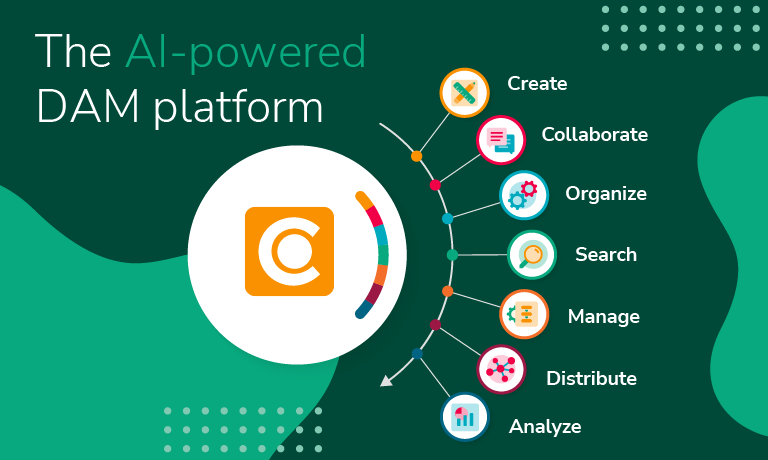
From the moment content is created to the moment it reaches its audience, every stage of the lifecycle is managed in one place, optimizing every content type and streamlining work for every team that touches it. Brand Studio gives teams AI-powered brand templates to create on-brand content from the start. Approval Hub streamlines collaboration and review. AI Library Assistant organizes and tags every asset using your taxonomy, keeping your library consistent at scale. AI Visual Search gives teams instant access to everything in your library. DAM for Products organizes assets around products with built-in rights management to protect every asset along the way (and without needing to integrate a separate tool). Finally, Media Publisher delivers assets to the right channels in the right formats in a matter of clicks. And Canto AI runs across all of it, helping teams work as efficiently as possible. This isn’t AI limited to one part of your workflow; it’s intelligence built across every stage of the content lifecycle, from creation to delivery.
PhotoShelter
PhotoShelter’s lifecycle support is limited to what it was built for: ingestion and distribution. Approval workflows are basic, governance tools are constrained, and integrations largely focus on photographer, sports, and social workflows, with limited native connections to enterprise MarTech and CRM platforms. HubSpot and Salesforce integrations are notably absent from PhotoShelter, while Canto offers broader coverage across marketing, sales, and productivity tools. The further your organization’s needs extend beyond media ingestion and distribution, the more PhotoShelter falls short.
Bottom line: A DAM that only serves part of your organization isn’t a DAM; it’s a limited tool with a DAM price tag. G2 reviewers rate Canto higher than PhotoShelter across every media type and every satisfaction metric that reflects organizational breadth: Ease of Admin, Ease of Doing Business With, and Product Going in Right Direction. Those gaps reflect what happens when a platform is built for one set of workflows and asked to serve all of them. Canto was built for all essential workflows from the start and hasn’t stopped innovating since.
Brand governance without the extra cost
In the era where AI is accelerating content production across every industry, brand differentiation has never mattered more or been harder to protect. The organizations that win are the ones with a governance infrastructure that can keep pace: consistent brand standards, controlled asset access, and the ability to enforce both at scale. Canto is built for that; PhotoShelter isn’t.
| G2 metric | Canto | PhotoShelter |
|---|---|---|
| Brand Guidelines | 87% | 80% |
| Versioning | 86% | 80% |
| Brand Portal | 89% | 85% |
| Analytics | 80% | 74% |
Canto
Canto’s brand management suite is built for the full scope of what governance actually requires. Brand governance only works when every team touching your content is working from the same rules, and Canto is built to enforce those rules. Every plan includes unlimited Portals and unlimited end users with granular access controls, interactive Style Guides to maintain brand standards, Digital Rights Management, approval workflows, asset expiration dates, and analytics in the foundational platform. That means adoption and enforcement of brand standards become truly scalable. When your DAM platform fully supports brand governance, consistency isn’t something you have to police. It’s built in.
PhotoShelter
For all but the Enterprise plan, PhotoShelter’s portal model is limited to a single portal. For organizations below the Enterprise tier that need to distribute content to multiple distinct stakeholder groups, this constraint requires tedious workarounds. Brand customization and style guide capabilities are also limited. Adobe integrations (a standard requirement for most brand and creative teams) are add-on features not included in base plans, further falling short of what modern teams require.
Bottom line: G2 reviewers rate Canto significantly higher on brand governance metrics. That gap reflects a suite depth difference. Canto’s brand management capabilities are more comprehensive, more connected, and designed for teams beyond the media department.
Transparent pricing that scales with your needs
DAM pricing is rarely as simple as the initial quote suggests. The real cost of a platform emerges over time, through add-on fees, integration costs, and tier upgrades required to access capabilities that should come standard. For organizations evaluating both platforms, understanding what’s included versus what costs extra is one of the most important comparisons to make.
Canto
Canto is designed to give teams the platform they need out of the box without the hidden cost. Unlimited end users, unlimited Portals, and Adobe Creative Cloud integration are included in the core plan. Canto AI is embedded directly into the platform where teams work, not dependent on tiers. For teams that want to go further, Canto offers add-ons across the content lifecycle, including Brand Studio, Approval Hub, and Media Publisher. Implementation is led by Canto DAM specialists who scope it transparently upfront, and the results bear that out: 2.3 months to go live and ROI in 12. The price you’re quoted is the price you plan around, and the results show up faster than the alternative.
Additionally, every Canto customer gets access to Canto Academy: self-paced, on-demand resources from Canto’s own DAM experts, available when your team needs them.
PhotoShelter
PhotoShelter’s pricing is tiered and structured around photographer-focused packages. Adobe integrations, a standard requirement for most brand and creative teams, are add-on features not included in base plans. According to PhotoShelter’s privacy page, customers must also use Socialie, adding another product to your tech stack and another contract to manage. Socialie operates under entirely separate legal terms (its own EULA, Privacy Policy, and Data Processing Agreement) and a separate login, functioning as a distinct product within the PhotoShelter ecosystem. Pricing for enterprise brand use cases requires direct inquiry and offers less flexibility than standard tiers suggest.
Bottom line: Predictable pricing matters more over time than at signing. Add-on fees for integrations that should come standard, and tiers designed around photographer use cases rather than enterprise brand teams, can make PhotoShelter’s total cost of ownership harder to forecast as your organization’s needs grow. Canto’s inclusive model means the platform you evaluated is the platform you get, and best-in-class implementation, plus Canto Acad
emy, means your team keeps getting more from it.
Security your marketing team can own
Enterprise security shouldn’t require IT to babysit it. The most effective permission models are the ones marketing and operations teams can configure, manage, and update themselves, without filing a ticket every time access needs change.
Canto
Canto’s permission model is built to put the teams that use it daily in the driver’s seat. Role-based access control (RBAC) works at the folder, album, and individual asset level, including watermarking, download restrictions, and guest access management. SAML 2.0 SSO integrates with Okta, Azure AD, and other major identity providers. MFA, audit logging, and 24/7 platform monitoring are standard. In short, the people who own the content own the access model.
PhotoShelter
PhotoShelter provides sharing permissions, SSO, and visibility controls. G2 reviewers rate Canto five points higher on User, Role, and Access Management (89% vs. 84%). As organizations scale and access needs become more complex, PhotoShelter’s permission model, packaged within tiers rather than configurable at a granular level, creates friction that compounds.
Bottom line: Security reviews are only the beginning. The real test is whether your team can manage access day-to-day without overhead. Canto’s granular, self-serve permission model means your content governance stays in the hands of the people who understand it best, and scales without friction as your organization grows.
30 years building DAM for every role, including photographers
When you choose a DAM vendor, you’re making a bet on their roadmap as much as their current feature set. The question worth asking is whether the platform you’re evaluating has been consistently investing in the full scope of digital asset management, or whether it has been optimizing for a specific slice of it while the rest of the market moves on.
Canto
Canto has over 30 years of focused investment in digital asset management, from launching one of the first DAM solutions to advancing AI across the content lifecycle, and unifying digital assets and product content with DAM for Products. That history includes deep investment in photographer and media workflows: Canto direct capture supports camera-to-DAM ingestion for photographer workflows, and AI Visual Search, facial recognition, and video capabilities serve the same media-heavy use cases and industries PhotoShelter addresses. The difference is that Canto also serves every other team in the organization. Modern organizations, including sports, education, and media organizations, don’t just need fast ingestion and distribution. They need approval workflows, brand portals, content governance, and comprehensive integrations, too. Canto is built for all of it.
PhotoShelter
PhotoShelter’s platform is purpose-built for a narrow audience (photographers, sports and media organizations, and education institutions) and its workflows reflect that. For organizations outside those use cases, or organizations within them that need more than ingestion and distribution, the platform’s scope becomes a ceiling rather than a foundation.
Bottom line: When evaluating a long-term platform partner, it’s worth asking whether the platform is built for where your organization is going, not just where it is today. A DAM built around a narrow audience will always prioritize that audience’s workflows over everyone else’s. Canto has served photographer, sports, education, and media workflows for 30 years alongside every other team and industry that touches content. That breadth doesn’t happen by accident. It’s built into Canto’s product from the beginning, on purpose.
Why brands choose Canto vs. PhotoShelter
Choosing the right DAM platform is ultimately a decision about what your whole team can adopt, scale, and get lasting value from. Canto is built around that reality.
With a G2 score of 91 (compared to PhotoShelter’s 66) and the most DAM reviews on G2, Canto is the most evaluated and most highly recommended platform. Canto customers see ROI in 12 months on average (compared to PhotoShelter’s 21). That advantage is built on AI search that works across every asset type without manual tagging, a core plan that includes unlimited Portals and users, and a single platform that manages every stage of the content lifecycle.
For teams evaluating PhotoShelter alternatives, the choice ultimately comes down to this: a platform built around a narrow set of workflows that leaves the rest of your organization underserved, or a DAM built for every team that touches content. Canto delivers the stronger, broader platform.
