Canto vs. MediaValet
Canto is a DAM leader pushing the bounds of what AI DAM can do, outpacing MediaValet on the G2 metrics that define category leadership.
Same category. Different experiences and a meaningful gap in product innovation. Here’s what separates two DAM solutions across AI, brand management, integrations, pricing, and security.
MediaValet and Canto are both built for organizations of varying scale, and at a feature level, they share common ground: AI-powered search, video management, unlimited users, and CDN capabilities. The difference is in how far each platform has pushed the boundaries of what a DAM can do, and for most teams, that gap is widest where it matters most.
Who is Canto?
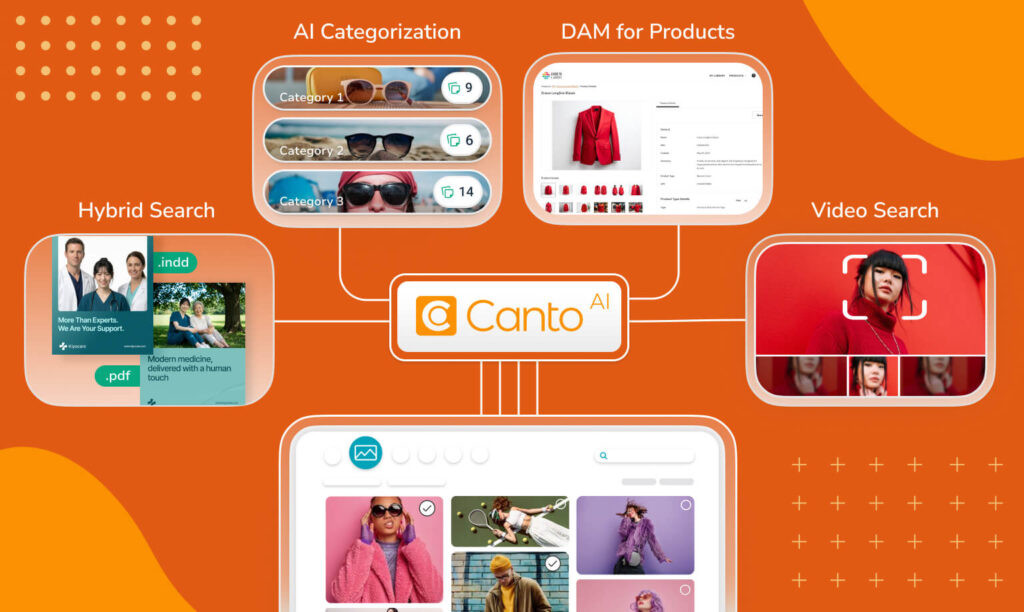
Canto is the original DAM pioneer, with 30+ years of DAM expertise and 4,000+ brands worldwide, pushing the bounds of what AI DAM can do. Its AI-powered platform goes beyond tagging with natural language, hybrid, and video search — plus jump-to-timestamp for faster video discovery. Combined with DAM for Products, unlimited Portals, and a 90%+ native integration library, Canto delivers enterprise-grade AI DAM in a platform that teams actually want to use.
Who is MediaValet?
MediaValet is a DAM platform built on Microsoft Azure, serving 500+ organizations. It includes AI search, video management, brand portals, and integrations with Microsoft, designed for organizations with existing Azure infrastructure.
What are the key differences between Canto vs. MediaValet?
- AI that searches deeper, faster. Canto’s hybrid search combines visual recognition, natural language, and an organization’s own metadata in a single query, including frame-level video search with jump-to-timestamp capabilities. MediaValet applies keyword and visual tags but doesn’t unify those results with organization-specific metadata in one search experience, and video search requires transcripts to be present and accurate.
- Product asset management, unified. Canto DAM for Products solves product data consistency issues for brands that sell products. The capability connects asset management and product attributes natively, with no integration or additional PIM required. MediaValet has no equivalent capability.
- More integrations, fewer dependencies. Canto’s integration library is 90% native connectors — built and maintained without third-party licensing. MediaValet’s Adobe Creative Cloud connection runs through CI Hub, a third-party connector with its own licensing cost, and its broader ecosystem leans heavily on the Microsoft stack.
G2 ratings comparison: Fall 2026
Canto is the most popular DAM platform on G2 by review volume and holds a significant lead on Overall Customer Satisfaction, Overall G2 Score, and Market Presence.
| G2 metric | Canto | MediaValet |
|---|---|---|
| Satisfaction | 100 | 87 |
| Implementation Time | 2.3 months | 2.9 months |
| G2 Score | 91 | 76 |
| Market Presence | 82 | 65 |
Canto vs. MediaValet feature comparison
The table below compares Canto vs. MediaValet across the categories most relevant to DAM buyers evaluating mid-market and enterprise solutions.
| Feature | Canto | MediaValet |
|---|---|---|
| User interface & ease of use | Intuitive, clean, fast adoption, minimal training | Clean interface, but more support is required during onboarding |
| Asset organization | Folders, AI-assisted metadata, AI-assisted categorization, Smart Tags | AI auto-tagging and folders; requires strict administrative discipline |
| AI-powered search | AI visual search, reverse image, visual similarity, hybrid search across all asset types, including video; jump-to-timestamp for video | AI metadata tags, facial recognition, and transcription; requires pre-applied tags or transcripts to search files |
| DAM for Products | Built-in | No native product information management capability |
| Brand management | Unlimited Portals, Style Guides, and DRM in core DAM; Approval Hub, Media Publisher, and Brand Studio can be added | Brand portals, brand guidelines, and templating via Marq integration; Experience Portals may be available as an additional add-on |
| Workflow & approvals | Multi-stage, linear approval workflows, Smart Compare, Smart Check, annotations, versioning | Built-in proofing and approval workflows |
| Integrations | Native: Adobe CC (included), Workfront, Slack, Salesforce, Shopify, and Amazon; 90% native connectors | Microsoft ecosystem (Azure, Office 365, SharePoint); Adobe integration via CI Hub (third-party) available as an add-on; open RESTful API |
| Implementation time | 2.3 months average | 2.9 months average |
| Analytics & reporting | Built-in usage analytics (downloads, shares, engagement tracking) for all customers | Basic built-in reporting; advanced insights require API connections |
| Security & permissions | Granular role-based access control (RBAC), simple to configure; SSO, MFA, 24/7 monitoring | SSO, MFA, complex user permission setup |
| Pricing model | Transparent: unlimited users and portals included | Custom pricing only; add-ons (Experience Portals, templating, proofing, cold storage, CDN Linking, AI, and CI Hub, which may be charged per user or require add-on purchases as reported by reviewers and MediaValet) significantly raise total cost of ownership |
AI features: Where the innovation gap widens
AI is one of the clearest areas of differentiation between the two platforms and one of the clearest expressions of the product innovation gap. The discrepancy shows most in search, video discovery, and library organization.
Hybrid search: one query, every asset type
Canto AI goes beyond generic AI tagging: it understands what’s in your content visually, learns how your organization names and categorizes assets, and surfaces the right result whether or not metadata exists. Canto AI Visual Search gives teams a unified way to scan their entire library for visual context, such as objects, people, and scenery in photos and videos, while simultaneously searching metadata fields like keywords, tags, and custom fields across all file types. There’s no toggling and no reliance on perfect tagging; teams can find content based on what’s actually in it.
MediaValet’s AI is built around tagging and transcription: useful, but dependent on clean metadata to function. MediaValet users must choose between “Smart Search” (AI-enabled) and legacy search; the two modes do not run together, which means teams are forced to toggle between views to find what they need. And because the AI search depends on pre-applied tags and transcripts, users not only need to know what they’re looking for, but also how to find it.
Video AI: find the moment, not just the file
Canto AI Visual Search scans video content visually, using object detection, facial recognition, contextual clues, and audio transcription, automatically surfaces the most relevant clip with jump-to-timestamp navigation, no transcript required. For teams managing any significant volume of video, this is a huge difference.
MediaValet does not support true visual search for video. Discoverability depends on transcripts, AI tags, and facial recognition. Timestamp navigation is only available when time-coded transcripts are present and match the search terms. That means teams in industries such as media and entertainment, sports, creative agencies, and other video-heavy environments will struggle to work efficiently without additional tools or integrations.
Library intelligence: AI that learns your organization
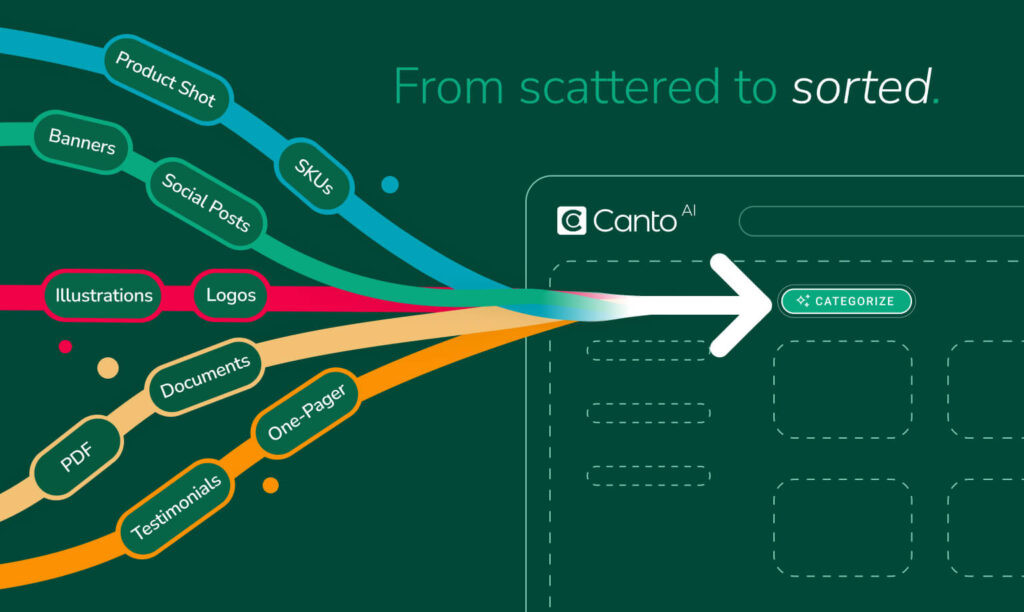
Canto AI Library Assistant analyzes an organization’s existing taxonomy, including how assets are already named, tagged, and categorized, and applies that understanding to new uploads. Metadata stays consistent with how your team actually works, rather than with what a generic model guesses. Over time, search becomes more accurate, and libraries stay organized without manual intervention at scale.
MediaValet’s auto-tagging assigns labels at upload based on visual detection. It does not adapt to an organization’s existing metadata conventions over time.
Bottom line: The AI gap between Canto and MediaValet isn’t a matter of features side by side: it reflects how much further Canto has pushed what AI inside a DAM can actually do. Canto AI works from day one, across your whole library, without dependency on pre-applied tags or transcripts. If your team needs to find the right asset fast, whether that’s an image, a product video, or a frame inside a clip, that difference is felt every day.
DAM for products: Where brand assets and product data come together
For brands managing product imagery, spec sheets, packaging files, and SKU-level content, a marketing-focused asset library only solves half the problem. The other half is connecting those assets to the structured product data behind them. This is an area where the two platforms diverge entirely; one has a native solution, and one doesn’t.
Canto
Canto DAM for Products is built into the platform: no separate system, no integration to maintain, no sync overhead between tools. Product data and creative assets live together, so teams can organize content around SKUs. When products are ready to launch, Canto integrates with e-commerce platforms like Shopify and Amazon and automatically maps product information to meet retailer requirements.
MediaValet
MediaValet does not include product management capabilities. Connecting product data to assets requires a separate platform, such as Akeneo via the Strikethru Connector, and a third-party integration to maintain with the associated extra costs. Every product update means a coordination exercise across platforms.
Bottom line: Building native product asset management into a DAM is a significant product innovation, and one MediaValet hasn’t made. New Canto research underscores why that matters: 78% of product-driven businesses still manage product content across two or more separate solutions, and only 38% use a centralized product information approach. By contrast, teams with full digital asset and product content connectivity are 4x more likely to report significant content ROI improvement (56% vs. 13%). For product-driven brands, MediaValet’s gap means a separate platform, a third-party integration to maintain, and added coordination with every product launch or update. Canto eliminates that overhead entirely.
Unified brand management as a platform advantage
Most DAM platforms include some version of brand portals and approval workflows. The more important distinction is whether brand content creation tools are unified within the platform or assembled through separate integrations, because that determines how tightly governance, production, and distribution stay connected as content volume scales.
Canto
Canto supports the full brand management stack in a unified platform with governance, content creation, and distribution all operating from the same asset library, metadata, and permissions. Every plan includes unlimited end users, unlimited Portals with granular access controls, interactive Style Guides, Digital Rights Management, approval workflows, and asset expiration dates. Brand Studio adds AI-powered template creation for scaling and localizing on-brand content. Approval Hub centralizes proofing and version tracking for complex review cycles, and Media Publisher automates media delivery to websites. Because all of these tools share the same asset library, there is no synchronization step between where content is approved and where it is distributed.
MediaValet
MediaValet supports brand management, but not in the same unified, scalable way as Canto. Experience Portals are an add-on to the core library, whereas Canto includes unlimited Portals in every plan. For templating and approval workflows, MediaValet relies on third parties to provide relevant capabilities. Despite MediaValet’s unlimited user model, the reliance on third-party software requires organizations to purchase additional seat licenses to access these benefits. Additionally, MediaValet relies on third parties to manage many of its integrations, requiring more seat licenses and adding another layer of cost and complexity to brand management.
Bottom line: Brand governance only works when the system behind it is complete. Canto has built that system as a unified platform: governance, creation, and distribution without switching tools. MediaValet assembles it from parts. That distinction shows up every time something in the brand needs to change.
Integrations built to last, not check a box
Modern brands need integrated marketing and creative technology to move quickly and stay on brand: without multiple vendor relationships and complex licensing to connect the tools, teams, and data.
Canto
Canto’s integration library spans roughly twice the number of connections MediaValet publishes, and 90% are native: built and maintained directly, without third-party connector licensing. Adobe Photoshop, Illustrator, InDesign, and Premiere Pro connect natively, as do Workfront, Slack, and Salesforce. Canto’s Adobe Creative Cloud connector is built and maintained by Canto, with no extra licensing or configuration required, so teams can start working in Adobe CC immediately. And for product-driven teams, Canto also connects natively to Shopify and Amazon: extending the DAM beyond content creation and into the channels where products are launched, merchandised, and sold.
MediaValet
MediaValet’s integration ecosystem is centered on the Microsoft stack. Adobe Creative Cloud is available through CI Hub, a third-party connector that carries its own licensing cost, requires more vendor management, and cost increases per user.
Bottom line: A 90% native integration library is itself a product investment, one that means fewer failure points, no third-party licensing surprises, and more predictable performance as your stack grows. Third-party connectors break, require separate renewals, and add maintenance overhead that your team absorbs. Canto’s native-first approach removes that burden.
Pricing, where the path to purchase splits
Both platforms include unlimited users, which removes one common DAM cost variable from the comparison. The difference is in how much buyers can learn upfront: Canto offers more visibility into plans and packaging early in the evaluation process, while MediaValet requires a custom quote. That makes MediaValet harder to assess independently and makes direct comparison less accessible without a sales conversation.
Canto
Canto gives buyers more upfront visibility into how the platform is packaged. Unlimited end users and unlimited Portals are in the core plan, and Canto AI is included where teams work, not gated behind an upgrade. Teams that want to extend further can add Brand Studio, Approval Hub, Media Publisher, or Canto DAM for Products, but the core platform is complete without them. You can evaluate what Canto can offer before you talk to anyone.
MediaValet
MediaValet does not publish plans or pricing. Cost is disclosed through a custom quote and varies by storage, integrations, and configuration. Unlimited users are included in the base. Key capabilities: Experience Portals, templating, proofing, cold storage, CDN Linking, AI features, and seats for third-party integrations are add-ons that raise the total cost of ownership, slow adoptions, and stall day-to-day work.
Bottom line: DAM software costs rarely end with the contract. When key capabilities require add-ons, AI sits behind an upgrade, and pricing is only available on request, forecasting your real investment becomes difficult. Canto’s inclusive model means the platform your team evaluates is the platform they get, at a price you can plan around.
Security and compliance
For teams evaluating certifications and permission control, both platforms cover much of the same ground. Both hold SOC 2 Type II, ISO 27001, GDPR, HIPAA, and CCPA certifications.
Canto
Canto’s security model is designed to be operated by the team that owns the DAM — not IT. Granular role-based access control works at the folder, album, and individual asset level, with guest access management, watermarking, and download restrictions all configurable without specialist involvement. SAML 2.0 SSO connects with Okta, Azure AD, and other major identity providers; MFA, TX-RAMP, PIPEDA, VPAT, EU AI Act, 24/7 platform monitoring, audit logging, and annual third-party penetration testing round out the stack.
MediaValet
MediaValet runs on Microsoft Azure. SOC 2 Type II, ISO 27001, GDPR, HIPAA, and CCPA certifications are included. SSO, RBAC, encryption at rest and in transit, and audit logging are available.
Bottom line: Both platforms pass enterprise security reviews. The difference is in who manages it afterward. Canto is built to be administered by the marketing or operations team that owns the system; no IT dependency required for day-to-day access management.
Why brands choose Canto vs. MediaValet
For mid-market to enterprise marketing and creative teams looking for a DAM platform with AI, native brand tools, product management, and organization-wide adoption without a lengthy implementation runway, Canto is the smoother path. The difference isn’t just feature-by-feature. It’s how much further Canto has pushed the boundaries of what a DAM platform can do: unified hybrid search across images and video, DAM for Products, 90% native connectors, clearer pricing plans, and faster time to go-live. That’s the compounding advantage of a platform that keeps innovating, and your team feels it from day one.
Frequently asked questions
Can MediaValet integrate with platforms like LinkedIn or YouTube?
MediaValet supports connections to platforms like LinkedIn and YouTube through third-party connectors and its open API, though few integrations are native. Canto offers a broader integration library, roughly twice the size of MediaValet’s, with 90% native connectors built and maintained without third-party licensing. For Adobe Creative Cloud specifically, Canto’s connector is native and included in the base plan; MediaValet’s requires CI Hub, a third-party tool with its own per-user fees.
How does MediaValet compare to other digital asset management solutions?
MediaValet is best suited for organizations with strict Microsoft Azure requirements, but it trails most competitors on key metrics. Its Fall 2026 G2 Score of 74 and Satisfaction score of 85 fall below Canto (91/100) and Brandfolder (74/67), though it outperforms Frontify (51/37). Implementation takes 2.9 months, slower than Canto’s 2.3 months, and like most competitors, it lacks native product management and gates advanced features behind paid add-ons. Canto leads across all major comparison points: G2 score, AI depth, implementation speed, and pricing.
What features does MediaValet offer for enterprise media management?
MediaValet offers AI-powered search, video management, brand portals, approval workflows, and integrations centered on the Microsoft ecosystem. However, its AI search requires pre-applied tags or transcripts to function and forces users to toggle between two separate search modes. Experience Portals, templating, proofing, CDN Linking, and advanced AI are available as paid add-ons. Canto offers all of these, adds frame-level video search with jump-to-timestamp without transcript dependency, and is the only major DAM with built-in DAM for Products.
What is the pricing structure for MediaValet services?
MediaValet does not publish pricing. Cost is determined through a custom quote based on storage, integrations, and configuration, with several key capabilities, including Experience Portals, templating, proofing, CDN Linking, advanced AI, and CI Hub seats for Adobe Creative Cloud, available only as paid add-ons. Canto outlines its plans upfront, with unlimited users and unlimited Portals included in its base plan.
