AI digital asset management: Transform how teams find, use, and scale content
Talk to an expert
Key highlights
- Understand what AI digital asset management is and how it benefits modern teams
- Learn how AI-powered DAM platforms help marketing, content, and creative teams work smarter
- Explore the technologies that make digital asset management AI more effective and scalable
What is AI digital asset management?
AI digital asset management (AI DAM) is the use of artificial intelligence to organize, tag, search, manage, and distribute assets automatically within a digital asset management platform. AI DAM builds on the structure of traditional DAM systems by using technologies like machine learning, computer vision, and natural language processing to automate metadata creation, improve asset discovery, and streamline workflows.
By combining typical DAM system features with AI to create a modern AI-powered DAM platform, teams can manage content at the speed and scale required today. These capabilities help marketing teams move faster, give creative teams more control over brand consistency, and provide organizations with a scalable structure for growing libraries of images, videos, documents, and design files.
The benefits of AI digital asset management
Digital asset management with AI gives teams an intelligent foundation for making the most of their content. By automating repetitive work like tagging, search, and version control, AI removes the manual steps that typically slow down marketing, content, and creative workflows. AI digital asset management benefits include:
Automated metadata generation
AI DAM platforms dramatically reduce manual content tagging. By analyzing incoming assets, AI assigns keywords, categories, and descriptive information — accelerating metadata management and freeing teams from hours of tedious work. Automatic tagging is especially valuable for high-volume libraries where metadata quality and consistency play a major role in asset findability.
AI DAM features:
- Automatic tagging: Scan and tag content with contextual information using AI
- HEX color recognition: Detect and label assets based on the HEX colors present
- Text recognition (optical character recognition): Recognize text within assets so content can be found by words they contain

Visual search and recognition
AI-powered search identifies people, colors, scenes, and similarities across assets. Features like image recognition and AI face recognition make it easy for teams to find the right asset even without perfect search terms or legacy knowledge. For teams with thousands of images or long-standing archives, this solves a major pain point and is one of the top advantages of AI in digital asset management USA teams prioritize.
AI DAM features:
- Face recognition: Detect repeated faces across assets and group them, making it easy to sort and discover related content
- Video recognition: Scan full videos to discover clips that match what users are searching for
- Transcription and captions: Generate transcripts and captions to improve searchability and accessibility
- Natural language processing: Search using natural language, no technical keywords or legacy knowledge required
Workflow acceleration
An AI-powered DAM that includes project feedback, annotation, and approval capabilities becomes the home base for the entire content lifecycle management. AI accelerates review and approval steps, routes tasks more efficiently, and automatically moves projects through key checkpoints. AI DAM streamlines production workflows for the increasingly interconnected MarTech systems used by modern organizations.
AI DAM features:
- Task routing: Suggest next steps or surfaces items requiring attention based on project activity
- Review support: Highlight changes, flag potential issues, or summarize feedback to speed up approvals
- Content version insights: Identifies differences between versions to help teams review faster
AI technologies powering today’s DAM systems
The AI technologies powering modern DAM systems give brands better governance of their content libraries. The ability to analyze visuals, learn from user behavior, and understand relationships between assets, means these technologies increase the accuracy and efficiency of core DAM functions.
Computer vision
Computer vision analyzes images at a granular level to identify patterns and structures. An AI DAM platform using computer vision can instantly interpret visual elements to improve asset organization, tagging accuracy, and search relevance.
Machine learning
Machine learning continually refines how a DAM AI system categorizes and ranks assets. The basics of machine learning include identifying patterns in data, adjusting predictions based on feedback, and improving accuracy with continued use.
Deep learning
Deep learning models support advanced visual search, asset clustering, and duplicate content detection. Deep learning uses stacked layers that recognize patterns, learn from examples, and improve how accurately a DAM AI platform identifies and groups visual content.

How AI digital asset management helps marketing and creative teams
AI DAM supports the distinct needs of marketing, content, and creative teams — all of whom depend on reliable, accessible assets.
How AI digital asset management helps marketing, content, and creative teams
Marketing, content, and creative teams all depend on fast access to accurate, up-to-date assets — and all three groups lose time when libraries are disorganized, search is ineffective, or version control breaks down. AI digital asset management solves these shared challenges by centralizing assets, automating routine tasks, and improving search and discovery across the entire content lifecycle.
DAM platforms like Canto use AI to automatically smart tag assets, recognize visuals, detect text and colors, and identify duplicates, reducing the manual work that often slows teams down. With one intelligent system handling organization and retrieval, teams spend more time creating and executing — and less time hunting for files.
How DAM AI strengthens team workflows
- Instant, accurate search: AI surfaces the most relevant assets immediately, helping teams assemble campaigns, build content, and fulfill requests without back-and-forth delays.
- Smarter organization: Canto’s platform auto-categorizes assets, suggests metadata, and version controls keep everything up to date, giving every team a structured, dependable workspace.
- Faster collaboration: AI streamlines annotations, and approvals so teams can track updates and move projects forward without unnecessary bottlenecks.
- Brand consistency at scale: AI-driven checks, version visibility, and permission controls help ensure only approved, on-brand assets are used across marketing and creative outputs
- More time for higher-value work: With administrative tasks automated, teams can focus on strategy, storytelling, design, and campaign execution.
The future of DAM AI
The rise of AI digital asset management marks a major turning point in how organizations approach content operations. As asset libraries grow across industries, AI has become a major asset for managing everything from brand assets to product content.
The future of DAM AI will be defined by:
- Unified intelligent content hubs
DAM platforms are evolving from a storage repository into an intelligent content hub where teams can create, collaborate, manage, publish, and analyze content in a single platform. AI will unify these stages, eliminate tool sprawl and enable teams to work in one coordinated workflow.
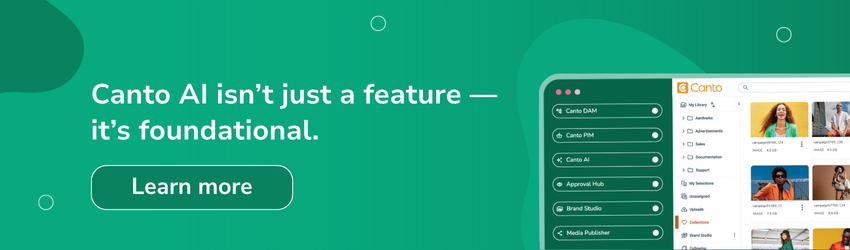
Industry insight: Canto AI is embedded at the core of the Canto platform to streamline the entire content lifecycle.
- Predictive, proactive content management
Rather than simply reacting to uploads and searches, digital asset management AI will proactively surface what teams need next. This includes content recommendations, automated quality checks, and predictive tagging based on past behavior and upcoming campaign activity.
Industry insight: Canto’s AI Library Assistant organizes and suggests metadata at upload to save hours of tedious manual sorting and labeling.
- AI-driven brand governance
Brand consistency will increasingly be protected by automated systems. AI will monitor usage patterns, flag inconsistencies, prevent outdated assets from being used, and provide guidance on whether content meets current brand standards. This will help organizations scale without sacrificing brand integrity.
Industry insight: AI Visual Search, in the Canto platform, detects blurry, non-compliant, and off-brand assets to ensure only high-quality content is used.
- End-to-end workflow intelligence
Future DAM AI systems will understand the entire lifecycle of a project — from ideation to delivery. They’ll connect assets, people, and processes automatically, shortening review cycles, guiding feedback, and reducing repetitive handoffs.
Industry insight: Canto’s Approval Hub accelerates project timelines with assigned roles, automated reminders, and centralized feedback.
- Multimodal content understanding
AI will analyze images, audio, video, documents, and motion graphics with the same depth and accuracy. This multimodal intelligence will enable deeper search, richer metadata, and stronger insights into content performance and relevance.
- Personalized asset experiences
Teams will receive results, recommendations, and workflows tailored to their roles. Marketers may see campaign-ready suggestions; designers may see similar layout references; content teams may get text-based insights. This level of personalization will significantly improve both productivity and asset reuse.
As these capabilities mature, organizations that adopt AI-enabled DAM systems early will gain a measurable advantage in speed, consistency, efficiency, and brand impact.
Why Canto is the best AI digital asset management platform
Canto pioneered digital asset management more than 30 years ago — and content has evolved dramatically since then. What we create, how we use it, and the way it must be managed have all changed.
That’s why Canto has transformed the traditional DAM into something more powerful: an AI-powered intelligent content hub. It’s a unified platform that streamlines every stage of the content lifecycle with advanced automation and intelligence.
Canto helps teams centralize assets, collaborate seamlessly, maintain brand consistency, and scale content production with ease. With Canto’s AI-driven platform, teams can create, collaborate, and distribute content with greater clarity, speed, and confidence.