
Best Bynder alternatives: 5 DAM platforms compared

Bynder’s name recognition brings a lot of teams to its door, but that doesn’t mean it’s the right fit once they’re inside. Pricing that compounds as you scale, a platform that needs a dedicated administrator to run well, a wide range of capabilities that are only accessible through add-on modules, and a slow implementation timeline: these are some of the reasons teams start looking elsewhere.
The best Bynder alternatives in 2026 are Canto, Brandfolder, Frontify, Air, and MediaValet. The right one depends on your team size, how much admin overhead you can absorb, and what you need the platform to do beyond core asset storage.
Bynder alternatives at a glance
| Platform | Best for | Pricing model | Setup effort | Standout capabilitiy |
|---|---|---|---|---|
| Canto | Mid-market and enterprise marketing teams | Transparent, flat; unlimited users and Portals | Low | AI hybrid search across images and video |
| Brandfolder | Teams in the Smartsheet ecosystem | Quote-based; add-on fees apply | Moderate | Analytics; Smartsheet integration |
| Frontify | Brand teams focused on guidelines and portals | Quote-based; charge monthly active users (MAU) | Low to moderate | Brand guidelines platform |
| Air | Small creative teams wanting a lightweight visual workspcae | Credit-based; usage can compound | Low | Visual card-based interface; creative collaboration |
| MediaValet | Microsoft-standardized organizations | Quote-based | Moderate | Microsoft Azure infrastructure |
Why teams look for Bynder alternatives
The reasons tend to be the same: the price you’re quoted isn’t the price you’ll pay (AI capabilities, advanced features, user limits, and professional services are all separate line items), and according to G2’s Fall 2026 Enterprise DAM Grid, implementation takes an average of 4 months and average user adoption sits at approximately 44%.
Reviews on G2 and Capterra flag the same things: it’s hard to learn, heavy to administer, and hard to budget for. For marketing teams that want to own their DAM without a dedicated administrator, those are real problems.
The 5 best Bynder alternatives
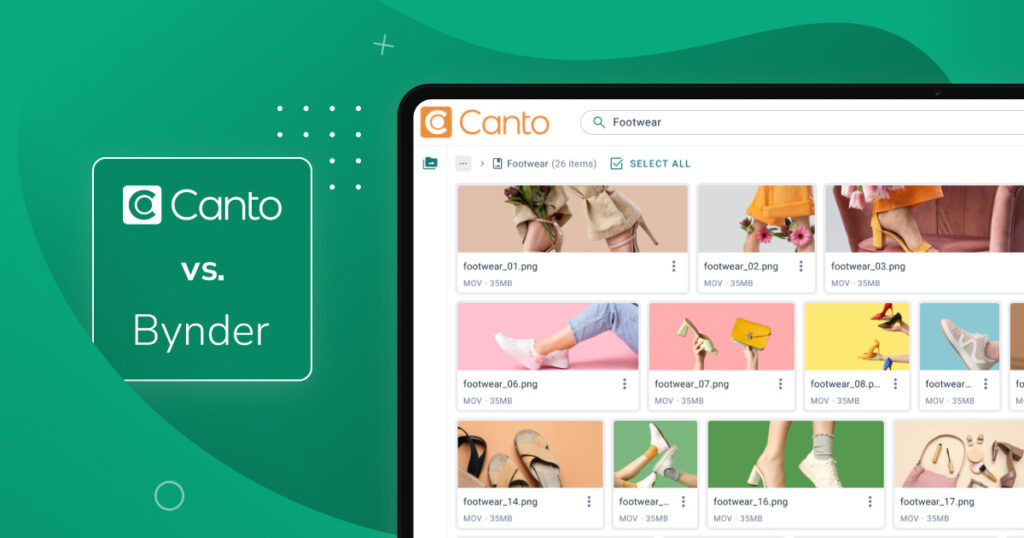
1. Canto
Best for: Mid-market and enterprise marketing teams that want a full-featured enterprise DAM they can own and run themselves.
Canto is the original DAM pioneer, with more than 35 years of focused investment in digital asset management (DAM) and 4,000-plus customers worldwide. Where traditional DAM platforms are passive repositories, Canto is built as an active DAM: a platform that works continuously in the background, organizing assets, surfacing content, and connecting continuously in the background, organizing assets, surfacing content, and connecting teams so your library gets more useful over time rather than harder to manage.
The difference shows up in the numbers. Canto’s average user adoption rate is approximately 60% versus Bynder’s 44% on G2’s Fall 2026 Enterprise DAM Grid. Implementation averages 2.8 month’s versus Bynder’s
Key strengths:
- AI search across images and video. Canto AI Visual Search works across your whole library in one experience. Type a description, search by image, or find a specific moment inside a video using facial recognition, audio transcription, and jump-to-timestamp.
- Built for marketing teams to own. Unlimited end users and unlimited Portals are included. Permissions are granular enough for enterprise security requirements, but simple enough for a marketing or ops manager to handle without IT.
- Brand management and product content together. Style Guides, unlimited Portals, Digital Rights Management, and approval workflows come standard. Canto DAM for Products also connects your assets to product data in one place, so you don’t need a separate product information management system.
- Security that doesn’t slow you down. SOC 2 Type II, ISO 27001:2022, GDPR, HIPAA, and CCPA certified. Built to pass enterprise security reviews without creating an ongoing IT dependency.
Main trade-off: Mid-market and enterprise marketing teams that want a full-featured enterprise DAM they can own and run themselves, with easier setup and faster implementation than Bynder. Very small creative teams with basic needs may find it more than they need at the start, though Canto is ranked as the #1 DAM for small business on G2 Fall 2026.
See the full Canto vs. Bynder comparison.
2. Brandfolder
Best for: Teams that rely on Smartsheet for work management and want their DAM connected to that ecosystem.
Brandfolder organizes assets through a flat tagging system and puts usage analytics front and center. It was acquired by Smartsheet in 2021, which makes it a natural fit for teams already running projects there.
Key strengths:
- Strong asset usage analytics
- Native Smartsheet connection for project and portfolio management
- Solid feature set for brand asset distribution
Main trade-off: Since the acquisition, DAM-specific development and support have taken a back seat to Smartsheet’s broader priorities. Add-on fees for Portals, stroage, and templating make costs harder to predict, and there’s no native video AI search. G2 puts ROI at 17 months for Brandfolder versus 10 months for Canto. Teams comparing Bynder vs. Brandfolder typically find Bynder stronger on governance and AI; the Brandfolder vs. Bynder argument really comes down to whether Smartsheet integration is worth the trade-off.
See the full Canto vs. Brandfolder comparison.
3. Frontify
Best for: Brand teams whose main need is a brand guidelines hub, with some asset management alongside.
Frontify is primarily a brand guidelines platform. Teams use it to publish and share brand standards, connect a brand portal, and maintain a basic asset library. If that’s the core of what you need, it does it well.
Key strengths:
- Strong brand guidelines publishing and portal experience
- Good fit for teams managing multiple sub-brands or agency partners
- Easy to use for non-technicaly brand managers
Main trade-off: Frontify isn’t really a DAM in the traditional sense. Teams with large media libraries, video, complex metadata, or serious distribution needs will hit its limits quickly. In a Bynder vs. Frontify evaluation, Bynder wins on asset management depth; Frontify wins when brand guidelines are the primary deliverable.
See the full Canto vs. Frontify comparison.
4. Air
Best for: Small creative teams that want a simple, visual workspace for organizing and reviewing creative work.
Air is built around a card-based visual interface and real-time collaboration. For small teams that mostly need a shared space to organize projects and give feedback, it’s fast to set up and easy to use from day one.
Key strengths:
- Clean visual interface that’s easy to get started with
- Real-time commenting and review tools for creative teams
- AI-assisted content editing
Main trade-off: Air is built for how content management starts, not where it goes. As teams grow, the gaps show up: no multi-step approval workflows, limited permissions, shallow integrations. Most teams outgrow it. The credit-based pricing model means storage, AI enrichment, and AI generation all draw from the same pool at different rates, so usage and adoption come at a cost that’s hard to predict as you scale.
See the full Canto vs. Air comparison.
5. MediaValet
Best for: Organizations running on Microsoft infrastructure with large, globally distributed asset libraries.
MediaValet is built on Microsoft Azure, which makes it a natural fit for organizations that are already standardized on Microsoft’s stack. It handles large libraries well and is designed for global teams that need assets delivered reliably across regions.
Key strengths:
- Native Microsoft Azure architecture for Microsoft-first organizations
- Built for large libraries distributed across global teams
- Strong enterprise security and complaince features
Main trade-off: If you’re not on Microsoft’s stack, a lot of MediaValet’s core advantage doesn’t apply to you. That said, unlike Bynder’s tiered user model, MediaValet includes unlimited users including admins.
See the full Canto vs. MediaValet comparison.
Which Bynder alternative is right for your team?
The right platform depends on what’s driving your search.
If pricing is the problem, Canto’s flat pricing with unlimited users and Portals makes costs predictable from the start. If admin overhead is the issue, Canto’s 2.8 month average implementation and 60% user adoption rate on G2’s Fall 2026 Enterprise DAM Grid data show what happens when a platform is thoughtfully built for the teams running it. If your team struggles to find assets, Canto AI Visual Search works across images and video in one place. For most marketing and creative operations teams, the answer is Canto.
The narrow exceptions: Brandfolder if you’re deeply invested in Smarsheet, Frontify if brand guidelines are your primary deliverable, Air if you’re a small creative team that needs something lightweight to start, and MediaValet if you’re standardized on Microsoft Azure.
Why Canto is the strongest Bynder alternative
A passive DAM stores your content and waits. Canto is built to act on it: organizing assets, surfacing content, and delivering it to the teams and tools that need it. For most marketing teams, that difference shows up fast.
60% user adoption versus Bynder’s 44%. Implementation in 2.8 months versus 4 months. ROI in around 10 months versus 13, per G2’s Fall 2026 Enterprise DAM Grid Report. More than 35 years of focused DAM investment, an intuitive platform, flat pricing, and unlimited users and Portals included.
Book a customized demo or take the on-demand product tour to see it firsthand.
Bynder alternatives FAQ
What are the best Bynder alternatives?
The best Bynder alternatives in 2026 are Canto, Brandfolder, Frontify, Air, and MediaValet. The right choice depends on your team size, admin capacity, budget, and what you need the platform to do beyond core asset management.
Who are Bynder’s main competitors?
Bynder’s main competitors in the enterprise and mid-market DAM space are Canto, Brandfolder, Frontify, Air, and MediaValet. For the full category view, see the best DAM software guide.
Is Brandfolder better than Bynder?
It depends on what you need. Brandfolder is simpler to set up and connects natively to Smartsheet. Bynder goes deeper on governance and AI. Teams that need Smartsheet integration tend to prefer Brandfolder; teams that want Bynder’s depth without the admin overhead tend to move to Canto.
How does Canto compare to Bynder?
Canto outperforms Bynder on G2’s Fall 2026 Enterprise DAM Grid for NPS, implementation time, user adoption, and estimated ROI. Canto is built for marketing and operations teams to own without IT involvement; Bynder is designed for organizations with dedicated DAM administrators.
How long does it take to switch DAM platforms?
DAM migration timelines vary widely based on library size, metadata complexity, and how many integrations need to be rebuilt. For a full breakdown of what to plan for, see switching to Canto.