Canto vs. WebDAM
Canto is a DAM-first company with AI search across images and video, a complete brand governance suite, and G2 ratings that show teams adopt it faster and see ROI sooner.

Two DAM platforms compared across search, AI capabilities, time to value, brand management, integrations, pricing transparency, and long-term product direction.
Canto and WebDAM are both established digital asset management (DAM) platforms that help marketing and creative teams organize, share, and distribute brand content.
While they were created to solve similar problems, Canto and WebDAM have taken different paths. Canto is an independent, DAM-first company investing in AI across the content lifecycle. WebDAM, now part of Bynder, is marketed around a more traditional feature set of faceted search, metadata, brand portals, and publishing. For teams evaluating both, the choice comes down to search, speed to value, and confidence in where the platform is headed.
Who is Canto?
Canto is the original DAM pioneer, with 35+ years of DAM expertise and 4,000+ brands worldwide. As a DAM-first company, Canto’s AI-powered platform is purpose-built for digital asset management at scale, combining AI-powered search, unlimited Portals, built-in workflow approvals and templating, DAM for Products, and dedicated implementation support, all in an intuitive experience any skill level can adopt.
Who is WebDAM?
WebDAM is a cloud-based DAM platform for marketing and creative teams. Shutterstock acquired it from its founders in 2014 and sold it to Bynder in 2018 for $49.1 million. Bynder markets it as “Webdam by Bynder,” with three offerings: Webdam (core DAM), Workstream (creative project management), and Brand Connect (brand portals and guidelines).
There is speculation that Bynder plans to retire WebDAM as a standalone product and force customers to migrate to the Bynder platform; Bynder has not publicly confirmed this at the time of writing and this is subject to change.
What are the key differences between Canto vs. WebDAM?
- A DAM-first roadmap you can plan around. Canto has spent 35+ years building DAM and continuing to innovate on its capabilities. WebDAM has changed owners twice since 2014 and now sits inside Bynder, which also sells its own flagship DAM. G2 reviewers rate Canto higher on “Product Going in the Right Direction” (91% vs. 78%).
- AI search across images and video. Canto AI Visual Search combines visual recognition, natural language, and your own metadata in one search, including video with jump-to-timestamp. WebDAM’s published materials describe their search capabilities as primarily keyword and metadata-based.
- Faster time to value. G2 reviewers report Canto has an estimated return on investment (ROI) of ~12 months, compared to WebDAM’s ROI of ~19 months.
G2 ratings comparison — Fall 2026
Canto is the most popular DAM platform on G2, rated 4.4/5 across 1,822 reviews. WebDAM, listed on G2 as Bynder Webdam, is rated 3.9/5 across 120 reviews. In G2’s side-by-side comparison, Canto scores higher on every satisfaction and ROI metric shown.
| G2 metric | Canto | WebDAM |
|---|---|---|
| Overall Satisfaction | 100 | 34 |
| Meets Requirements | 90% | 83% |
| Ease of Use | 89% | 81% |
| Ease of Setup | 85% | 80% |
| Ease of Admin | 89% | 82% |
| Quality of Support | 92% | 83% |
| Ease of Doing Business With | 93% | 83% |
| Product Going in the Right Direction | 91% | 78% |
| Estimated ROI | ~12 months | ~19 months |
What WebDAM reviewers have said
G2 and Capterra reviewers give WebDAM credit for an easy-to-use interface, broad file type support, and branded portals that work well for multi-brand organizations. The recurring concerns are performance, search depth, storage costs, and product direction. Many reviews are several years old, so read these as themes rather than a current snapshot.
- Performance: A Capterra reviewer called it “SLOW” with large files and said it crashed InDesign frequently. Another reviewer said it “takes a very long time to update” and sometimes disconnects.
- Search depth: A 2022 Capterra reviewer said search “is not as advanced as some other platforms” and that without metadata on an asset you can’t find it, while other tools use AI to search for objects in pictures.
- Storage costs: A 2019 higher-education reviewer said the college regularly runs out of cloud storage and has to buy more, including archival storage.
- Direction: A January 2025 Capterra reviewer said Bynder pushed them to transition off WebDAM, called the transition “horrible,” and said WebDAM “likely is reaching the end of its development cycle.” G2 reviewers rate Product Direction 75% for WebDAM versus 90% for Canto.
Sources: Capterra WebDAM reviews (9 reviews, 4.2/5); G2 Bynder Webdam pros and cons.
Canto vs. WebDAM feature comparison
The table below compares Canto vs. WebDAM across the categories most relevant to DAM buyers. WebDAM details come from Bynder’s WebDAM pages, G2, and reviewer feedback.
| Feature | Canto | WebDAM |
|---|---|---|
| Search | AI Visual Search across images and video; hybrid search; facial recognition built in | Search by metadata, file type, and keywords. No AI Visual Search or video search appear to be offered |
| Asset organization | Folders, AI-assisted metadata based on existing taxonomy, AI-assisted categorization for new uploads at scale, and Smart Tags | Download rules by folder, asset, or user type |
| DAM for Products | Built-in; no third-party integration needed | No native product information capability described, custom integrations likely required |
| Brand management | Unlimited Portals and Style Guides in the core plan; AI Quick Edits to streamline content creation, Brand Studio adds AI-powered templates | Brand Connect: branded portals, and digital brand guidelines, marketed as separate products |
| Digital Rights Management | Included in core platform; expiration dates, download controls, watermarking | Download rules by folder, asset, or user type |
| Workflow & approvals | Built-in approvals, annotations, versioning; multi-step review and Smart Compare with Approval Hub | Workstream: configurable creative briefs, approval paths, and markup |
| Distribution | Unlimited Portals, Media Publisher automates delivery to storefronts, websites, and distribution platforms | Direct publishing to CMS and social channels; file conversion and cropping at download |
| Integrations | 90% native: Adobe CC, Workfront, Slack, Salesforce, WordPress; Shopify and Amazon for product workflows | At least 39 listed, including Adobe CC, Salesforce, Workfront, Sitecore, Drupal, WordPress, and stock libraries. Several carry third-party provider labels |
| Analytics & reporting | Built-in usage insights for all customers | Usage and asset access reports |
| Customer support | Dedicated AMs and tailored implementation support for every account; Canto Academy self-serve resources, G2 rated Quality of Support 92% | G2 rated Quality of Support 83%; help center at damsuccess.com |
| Pricing model | Transparent, flat; unlimited users and Portals | Not published; G2 lists no pricing. Reviewers cite storage add-ons |
| Security & permissions | Granular RBAC at folder, album, and asset level; SSO, MFA, audit logging | AWS-based multi-zone infrastructure and CDN; permissions and download rules |
| Vendor focus | Independent, DAM-first company with 35+ years in the category | Owned by Bynder since 2018; third-party reports of planned retirement |
Faster to launch, faster to pay off
A DAM only delivers value once your team uses it, so implementation time and time to ROI matter as much as the feature list. G2 reviewers report an average implementation timeline of about 2.3 months for Canto versus about 2.7 for WebDAM, and estimated payback in about 12 months versus about 19. That seven-month gap is over two quarters where Canto is earning its keep while WebDAM is still working towards breaking even.
Canto
Canto’s AI-powered DAM, folder structure, clean interface, and guided onboarding led by DAM specialists mean teams are productive from day one. Every Canto customer receives a dedicated account manager and tailored implementation support regardless of contract size, and self-serve Canto Academy resources help teams keep improving. G2 reviewers rate Canto 92% for Quality of Support versus 83% for WebDAM. Canto continues to lead the DAM market with innovation, continuously using customer feedback to drive roadmap decisions and leverage the latest AI capabilities to drive customer outcomes.
WebDAM
G2 reviewers rate WebDAM lower on Ease of Setup (80% vs. 85%) and Ease of Admin (82% vs. 89%). Reviewers describe the interface as easy to use, but note the up-front decisions required on folder structure and metadata, and several report slowdowns with large files. Additionally, WebDAM’s most recent release notes were published in October 2024, meaning there is not significant investment in innovation, compared to Canto’s track record of innovation and timely updates.
Bottom line: Time to ROI is the most honest measure of whether a DAM is working. Faster implementation, higher admin ratings, and dedicated support mean Canto is built to deliver value sooner.
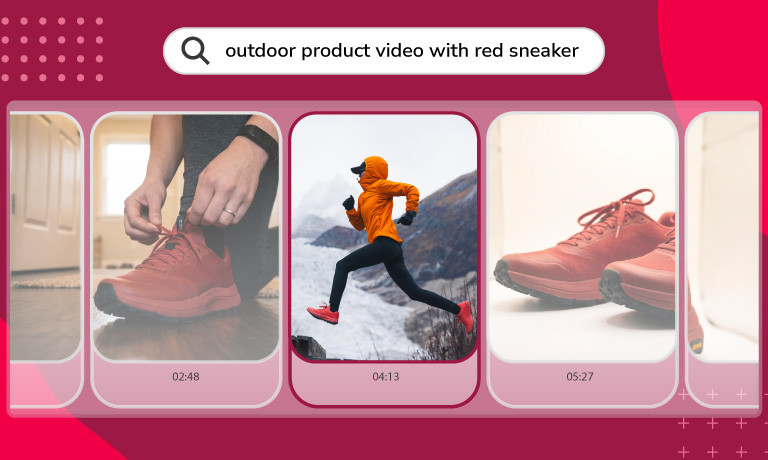
AI that finds what you need, including video clips
Search is where the platforms differ most. WebDAM’s own product pages describe faceted search and advanced filter searches. Canto has invested in AI that works across the whole Library.
One search for images and video
Canto AI Visual Search combines visual recognition, natural language queries, and your organization’s own metadata in a single, unified experience. For video, that means object detection, facial recognition, and audio transcription that let users jump directly to the relevant timestamp inside a clip, not just find the file.
WebDAM’s published feature set centers on faceted search by metadata, file type, and keywords. It describes does not describe visual similarity search, natural language search, or video search.
AI that learns how your team organizes
Canto AI Library Assistant learns your organization’s taxonomy and metadata structure over time, then recommends organization-specific tags for new assets so metadata stays consistent as your Library grows.
WebDAM’s suggested keywords are based on similar images and metadata already in use, which helps standardize tagging at upload. Canto goes further by applying learned taxonomy to new uploads at scale, so the manual tagging lift shrinks as the library grows.
The bottom line on AI
Canto’s 2026 State of Digital Content Report found that teams with mature, AI-supported workflows are twice as likely to see significant gains as those using AI in more fragmented ways (44% vs. 19%). If your team needs to find the right asset fast, whether that’s an image, a product video, or a frame inside a clip, Canto’s AI is built for it from day one.
One intuitive system for your assets and product data
When product data and brand assets live in separate systems, every launch, refresh, and regional variant needs a sync step someone has to own.
Canto
Canto DAM for Products combines asset management and product data in a single platform, with no separate PIM, no third-party integration, and no syncing logic to break. Finalized content can be pushed directly to storefronts, marketplaces, and partners, while Canto’s Amazon and Shopify integrations simplify product distribution. No need to manage another system for product data, DAM for Products centralizes data management, enrichment, and distribution across both brand assets and product data in a unified platform.
WebDAM
WebDAM does not offer the ability to manage product data natively, likely requiring a separate system to manage product information. Its integration page notes that it integrates with SAP Commerce Cloud, but not other major PIM systems; likely requiring a custom-built integration. Teams that need product data tied to their assets should expect to license and maintain another platform.
Bottom line: Canto research suggests 78% of product-driven businesses manage product content across two or more separate solutions, with only 38% using a centralized approach. Teams with full digital asset and product content connectivity are 4x more likely to see significant content ROI improvement (56% vs. 13%). Canto gives teams one source of truth for both the asset and the product information it represents.
A complete brand governance suite
Brand management is increasingly central to the DAM buying decision. WebDAM covers the basics, and the comparison comes down to depth and how much is included.
Canto
Canto is built for end-to-end brand management. Every plan includes unlimited Portals and unlimited end users with granular access controls, interactive Style Guides, Digital Rights Management, approval workflows, asset expiration dates, and analytics. Brand Studio adds AI-powered templates for on-brand content creation and localization, Approval Hub centralizes proofing and version tracking, and Media Publisher automates delivery to storefronts, websites, and distribution platforms.
WebDAM
WebDAM’s Brand Connect offers branded portals (multiple portals can serve different audiences), digital brand guidelines, and comment and like tools. Approval and proofing run through Workstream, a separate creative project management product.
Bottom line: Brand governance works when guidelines, content creation, approvals, and distribution live in one connected system. Canto delivers that without usage limits, and extends it with AI-powered templates and automated publishing.
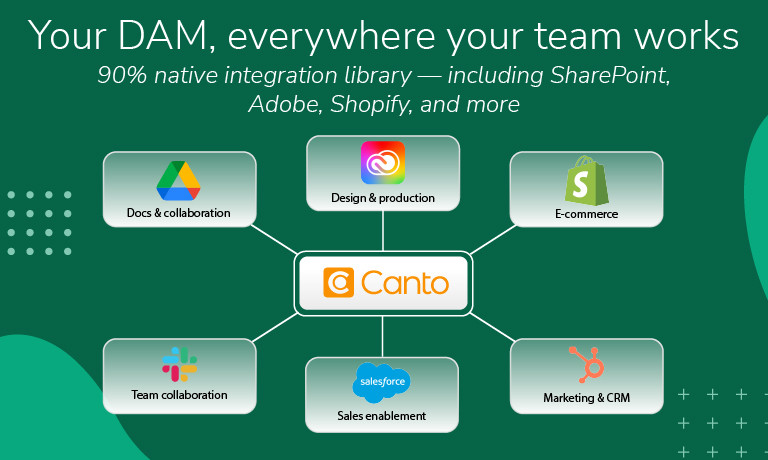
Integrations built to last
The integration ecosystem affects implementation effort and day-to-day reliability. Both platforms offer an API.
Canto
Canto’s integration library is 90% native connectors. Canto connects natively with Adobe Photoshop, Illustrator, InDesign, and Premiere Pro, as well as Workfront, Slack, Salesforce, and WordPress. For product-driven brands, Shopify and Amazon integrations streamline product workflows. Adobe Creative Cloud integration is included in the core plan.
WebDAM
WebDAM’s integrations page lists at least 39 connectors, with coverage of CMS and DXP platforms (Sitecore, Drupal, AEM, WordPress, Contentstack), cloud storage (Dropbox, Box, SharePoint, Google Drive), and stock libraries (Shutterstock, Getty, Adobe Stock, iStock). Several entries carry third-party provider names such as LinkrUI, which suggests partner-built connectors and could lead to additional licensing requirements.
Bottom line: Both platforms connect to the creative and CMS tools most teams use. Canto’s native-first approach means fewer failure points, less maintenance overhead, lower total cost of ownership, and its commerce integrations support product-driven teams.
The price you’re quoted vs. the price you’ll pay
Comparing DAM pricing means looking beyond the headline contract to implementation, storage, add-ons, and the cost of keeping the platform current over a multi-year term.
Canto
Canto is designed to give teams the platform they need out of the box. Unlimited end users and unlimited Portals are included in the core plan, and Canto AI is embedded directly into the platform, not offered as a separate tier. For teams that want to go further, Brand Studio, Approval Hub, and Media Publisher are available as add-ons. Implementation is led by Canto DAM specialists, with an average go-live of about 2 months.
WebDAM
WebDAM does not publish pricing. Workstream and Brand Connect are marketed as separate products from core Webdam, indicating that there may be additional costs to obtain the full capabilities of the platform.
Bottom line: Predictable pricing matters more over time than at signing. Canto’s inclusive model means you can forecast your investment with confidence, and your team can scale without watching the meter.
A vendor committed to getting DAM right
A DAM is a multi-year commitment, so the vendor’s direction matters as much as the current feature set.
Canto
Canto has over 35 years of focused investment in digital asset management, from launching one of the first DAM solutions to advancing AI across the content lifecycle and unifying assets and product content with DAM for Products. Its roadmap, leadership, and support organization are built exclusively around DAM.
WebDAM
WebDAM has changed hands twice, to Shutterstock in 2014 and to Bynder in 2018. Its G2 profile is managed with limited features, and G2 reviewers rate Product Direction at 78% versus 91% for Canto. There are rumors that Bynder plans to retire WebDAM and migrate customers to Bynder, though no public announcement has been confirmed. Based on WebDAM’s release notes, there has also been limited product development since October 2024.
Bottom line: When evaluating a long-term platform partner, ask whether DAM is the company’s priority or a product line it inherited. Canto has spent 35 years building a platform designed to push the DAM category forward.
Evaluating your options as a WebDAM customer?
If you use WebDAM today, the question is less “what’s better” and more “what’s next.” Whatever Bynder’s plans turn out to be, it helps to know your options before a decision is made for you.
- Get Bynder’s plans in writing: Ask whether WebDAM will continue, what the timeline is, what migration to Bynder would cost, and what your contract with Bynder will encompass.
- Compare the destination, not just the move: Bynder is a different platform from WebDAM. See how it stacks up in Canto vs. Bynder.
- Plan the migration: Audit your folders, metadata, and portals so you move the content you actually use. Canto’s DAM specialists scope implementation up front.
- Test with real content: Book a Canto demo or take the product tour with your own assets in mind.
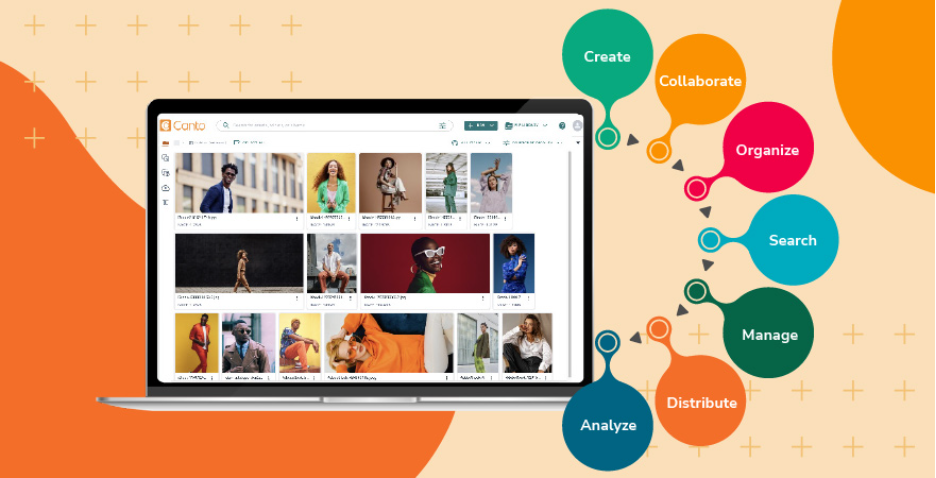
Why brands choose Canto vs. WebDAM
Choosing the right DAM platform is ultimately a decision about what your team can adopt, scale, and get lasting value from. Canto is built around that reality.
With a 4.4/5 rating on G2 and the most DAM reviews, faster implementation, faster ROI , AI search that spans images and video, unlimited users and Portals, DAM for Products, and dedicated DAM-specialist support for every account, Canto gives teams the power they need without complexity. For teams comparing WebDAM alternatives, the choice comes down to this: a platform with an uncertain future inside a larger vendor’s portfolio, or a DAM built by a company dedicated to advancing what a DAM is capable of. Canto delivers the stronger platform, with transparent pricing you can plan around.
Frequently asked questions about Canto vs. WebDAM
Is Canto a good alternative to WebDAM?
Yes. Canto is the most popular DAM on G2, rated 4.4/5 across 1,822 reviews versus 3.9/5 across 120 for WebDAM. G2 reviewers report faster implementation, faster ROI (about 11 months vs. 19), and higher scores for all satisfaction metrics. Canto also includes AI Visual Search across images and video, unlimited users and Portals, and built-in DAM for Products.
What are the main differences between Canto and WebDAM?
The biggest differences are search, AI capabilities, time to value, and vendor focus. Canto AI Visual Search covers images and video in one experience, while WebDAM’s published materials describe faceted search and image keyword suggestions. Canto is a DAM-first company; WebDAM is a Bynder product. Canto also extends its offering through DAM for Products, Media Publisher, Brand Studio, and Approval Hub.
Who owns WebDAM?
Bynder. Shutterstock acquired WebDAM from its founders in 2014, then sold it to Bynder in 2018 for $49.1 million. Bynder markets it as “Webdam by Bynder.”
Is WebDAM being discontinued?
Third-party sources suggest that Bynder plans to retire WebDAM as a standalone product and migrate customers to Bynder. We have not found an official Bynder announcement, and WebDAM’s status page still showed all systems operational in September 2026. If you use WebDAM, ask Bynder to confirm the timeline in writing.
Does WebDAM have AI search?
WebDAM’s product pages describe machine-learning keyword suggestions for uploaded images and faceted search by metadata, file type, and keywords. They do not describe visual or video AI search. Canto AI Visual Search covers images and video, with object detection, facial recognition, audio transcription, and jump-to-timestamp.
Does WebDAM have a product information management solution?
WebDAM’s published materials do not describe a native PIM. Its integrations page lists a PIM category for connecting a separate system. Canto offers built-in DAM for Products, combining assets and product data with no third-party integration.
More resources

Start with Canto
Make more of your content.
Bring your assets, teams, and workflows together. See what’s possible with Canto.