
Best brand management tools: A category guide

This guide breaks down the six core categories of brand management tools, what each one does, who needs it, and how to choose the right combination for your team. Because most brand consistency problems aren’t strategy problems; the guidelines exist. What breaks down is the system that makes everyone follow them.
Research by Marq found consistent brand presentation can increase revenue by 10 to 20 percent. The gap between that outcome and where most teams are is usually not a messaging problem. It’s a tools problem.
This guide breaks down the six core brand management platform categories, who needs each one, and two representative platforms in each to orient your search. For a grounding in brand management as a discipline, start with the brand management guide.
Editorial note: Tools listed here are representative examples based on market presence as of July 2026, not a ranked list. No vendor paid for inclusion. Verify current pricing and capabilities directly with each vendor.
The six categories to identify the best brand management tools for you
Before getting into individual tools, it helps to know which category covers which problem. Most teams need tools from more than one.
| Category | What it does | When you need it |
|---|---|---|
| Strategy and planning | Documents positioning, messaging frameworks, and brand architecture | Before execution begins; when brand decisions need a shared record |
| Visual identity and design | Produces logos, templates, campaign assets, and social graphics | Any team creating visual brand output |
| Social media management | Centralizes publishing, scheduling, and monitoring across networks | Teams managing multiple accounts, brands, or external agencies |
| Content and SEO | Measures brand authority in search and identifies competitive gaps | Teams investing in organic visibility and content strategy |
| Brand monitoring | Tracks online mentions, sentiment, and reputation risk | Organizations with significant public brand exposure |
| Brand asset governance | Stores, governs, and distributes approved assets from a single source of truth | Any organization producing brand content across more than one team or partner |
The categories aren’t interchangeable. Strategy tools define what the brand is. Design tools produce assets. Social tools publish content. None of them govern what gets out the door or keep everyone working from the same approved files. That’s where asset governance comes in, and why it’s the category that makes everything else work.
Strategy and planning tools
Before you can manage a brand, you have to document it. Strategy tools are where positioning, messaging frameworks, and brand architecture live. They don’t enforce anything; they create the record that every downstream team is supposed to work from.
Notion is widely used by brand teams for positioning docs, messaging frameworks, and competitive analysis. Flexible enough for early-stage teams building governance structures without dedicated brand infrastructure.
Miro is the go-to for visual collaboration: brand workshops, customer journey mapping, cross-functional alignment. It’s the better pick when brand decisions need to be made together across distributed teams, not just written down after.
Industry tip: Strategy tools tell you what the brand is. They don’t stop anyone from publishing something off-brand. You need a governance layer for that.
Visual identity and design platforms
Design tools turn brand strategy into the actual assets: logos, templates, campaign graphics, social imagery. The right one depends almost entirely on who’s doing the work.
Adobe Creative Cloud is the professional standard for teams producing high-quality assets at volume. Right choice when precise control over output is required and design expertise is on the team.
Canva gives non-designers a way to produce on-brand content through brand kits that lock logos, colors, and fonts within templates. Widely adopted for everyday content like social graphics and presentations where you can’t route everything through a designer.
Industry tip: The most common design tool failure isn’t output quality. It’s file management. If assets are saving to individual drives instead of a central library, you’re building a version-control problem.
Social media management tools
Scheduling is the easy part. The brand consistency problem in social management is whether off-brand content can get published without review, and whether brand mentions get caught before they spread. That’s what to evaluate.
Hootsuite holds the largest market share among dedicated social management platforms, with multi-network support and team permission controls that matter most when you’re managing multiple brands or regional accounts. (Source: 6sense, 2026.)
Sprout Social integrates social listening, publishing, and CRM in one platform. The stronger pick when social data needs to connect with broader customer relationship workflows, not just run as a separate publishing channel. (Source: 6sense, 2026.)
Industry tip: Approval workflows matter more than scheduling features in this category. A platform that can publish without review doesn’t solve the off-brand content problem.
Content and SEO tools
If you’re investing in content, you need a way to measure whether it’s building brand authority in search or just adding to the noise. That’s what this category covers.
Semrush is the broader all-in-one platform: SEO, content strategy, PPC, competitive intelligence. Led in market share at 32 percent among SEO professionals in an Authority Hacker survey of 3,000-plus respondents. Right choice when you need coverage across multiple channels from one place.
Ahrefs goes deeper on backlink analysis and competitive content research. At 24 percent in the same survey, it’s the preferred tool for teams whose primary focus is building authority through content and link acquisition.
Industry tip: These two overlap a lot. If you can only pick one, Semrush is the broader all-in-one; Ahrefs is the deeper specialist on backlinks and content. Many teams use both.
Brand monitoring tools
You can’t manage what you’re not tracking. Brand monitoring tools watch for your brand’s name across social, news sites, forums, and review platforms so issues don’t compound before anyone notices.
Brandwatch is built for enterprise-scale monitoring, using AI-powered sentiment analysis across a large source network. Right for high-volume consumer brands and organizations in sensitive industries where reputation risk is real.
Mention covers social media, news, forums, and review platforms with real-time alerting. The practical mid-market option for teams that need more than free tools but don’t need enterprise-scale data volume.
Industry tip: Match the tool to your actual risk exposure. Most early-stage companies can start with free tools. Once your brand is public-facing at volume, a dedicated platform pays for itself.
Brand asset governance
This is the category that makes all the others work. A brand asset management platform stores, governs, and distributes your approved assets from a single source of truth. Without it, the outputs of your strategy, design, social, and content tools end up scattered across drives and inboxes, and enforcing brand standards becomes a full-time manual job.
It’s worth being specific about what “governance” actually means here: approval workflows so content doesn’t ship without review, permission controls so the right people access the right assets, version history so outdated files don’t make it into campaigns, and brand portal capabilities so agencies and regional partners can self-serve current assets and brand guidelines without going through someone at HQ every time.
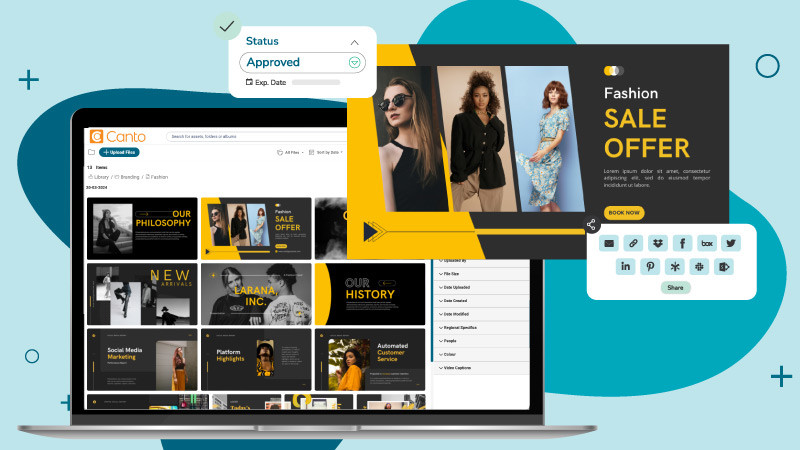
Canto is one example of a DAM platform purpose-built for brand asset governance.
Industry tip: A shared drive is not a digital asset management (DAM) platform. The difference isn’t storage capacity or folder organization. It’s enforcement: approval workflows, locked templates, and expiration controls that catch off-brand content before it reaches market, not after.
Where Canto fits
Most brand consistency problems are not strategy problems. The guidelines exist. What breaks down is the system that makes everyone actually follow them.
Canto has spent more than three decades helping define the DAM category and continuing to push it forward, building toward the most robust brand management platform on the market. The platform combines a centralized asset library, AI Library Assistant for auto-sorting and tagging content and asset discovery, AI Visual Search for finding assets by color or visual similarity, Approval Hub for review and sign-off, Brand Studio for interactive guidelines, and Media Publisher for direct channel distribution, so every asset is findable, every workflow has a clear path, and nothing ships without the right sign-off.
For a full breakdown of buyer criteria and platform comparisons, see the brand management software guide.
Frequently asked questions about best brand management tools
What’s the most important brand management tool to invest in first?
For most teams past the startup stage, an asset governance platform. It addresses the broadest set of brand consistency problems at once: version control, approval workflows, partner access, and distribution. It also makes every other tool in the stack more effective because everyone is working from the same approved files.
How are brand management tools different from project management tools?
Project management tools track tasks. Brand management tools govern the assets and standards those tasks produce. You can use both: project management for timelines, brand management tools for controlling what gets approved, published, and distributed.
Is a DAM platform the same as cloud storage?
No. Cloud storage organizes files. A DAM platform governs brand assets through approval workflows, permission controls, metadata tagging, rights management, and asset expiration. The distinction matters most when you’re managing content across multiple teams, agencies, or regions.
Editorial note: Tool descriptions are based on publicly available information as of July 2026. Market share figures are sourced from 6sense (2026) and an Authority Hacker survey of SEO professionals. The Marq revenue figure is from Marq’s published brand consistency research.