
Brand guidelines: What they are and how to create them

Brand guidelines are a documented set of rules that define how a brand looks, sounds, and presents itself across every channel and touchpoint. They specify how to use a logo, which colors and fonts represent the brand, what tone of voice to use in copy, and how imagery should feel, giving every person who creates content on behalf of the brand a single source of truth for all of their digital assets.
Without brand guidelines, even well-intentioned teams produce inconsistent work. A designer picks the wrong shade of blue. A copywriter writes in a tone that feels off. An agency uses an outdated logo. Guidelines prevent all of that; not by restricting creativity, but by channeling it.

What are brand guidelines?
Brand guidelines, sometimes called a brand guide, brand style guide, or brand guideline document, are the rules that govern how a brand is represented visually and verbally. They exist to ensure that every piece of content, from a social post to a trade show banner to a product page, looks and sounds like it came from the same organization.
A strong brand guideline document covers both visual identity (logos, colors, typography, imagery) and verbal identity (tone of voice, messaging, what to say and what to avoid). Some organizations publish abbreviated versions for external partners; others maintain comprehensive internal guides that go deep on every element.
The terms “brand guidelines” and “style guide” are often used interchangeably, but there is a distinction. A style guide typically focuses on writing (grammar, punctuation, preferred terminology). Brand guidelines are broader, covering the full visual and verbal identity of the organization.
Why brand guidelines matter
Consistency across every channel
Consumers encounter a brand across dozens of touchpoints, like email, social media, paid ads, packaging, events, sales materials. Brand guidelines ensure that every touchpoint reinforces the same identity. According to a survey of more than 400 brand management experts conducted by Marq, organizations that present their brand consistently can expect a 10-20% increase in overall growth.
Consistency compounds over time. The more times a customer sees the same logo, the same color, the same tone of voice, the stronger the brand recognition becomes. Guidelines make that repetition deliberate rather than accidental.
Faster execution for your team
When designers, writers, and marketers have clear rules to work from, they spend less time agonizing over simple decisions and more time producing work. A designer who knows the exact hex codes, approved typefaces, and logo clearance rules does not need to ask. A writer who has a tone of voice section does not need to guess.
Brand guidelines reduce the back-and-forth that slows production, especially for teams working with external agencies, contractors, or regional partners who are not embedded in the brand day-to-day.
Stronger brand recognition
Strong brand recognition is built through repetition. When your visual identity is consistent, audiences learn to recognize you before they even read your name. Think of how instantly recognizable a Target red or a Tiffany blue is. That recognition is the result of years of disciplined adherence to guidelines.
For mid-market brands competing against larger, better-resourced competitors, brand recognition is a force multiplier. It makes every marketing dollar work harder.
Risk mitigation
Off-brand content is more than just an aesthetic problem; it’s a business risk. Incorrect logo usage can create trademark issues. Inconsistent messaging can confuse customers and undermine sales. In regulated industries, off-brand or unauthorized content can create compliance exposure.
Brand guidelines give teams a defensible standard. When someone publishes something that does not meet guidelines, the correction is clear and documented.
What should brand guidelines include?
Logo usage
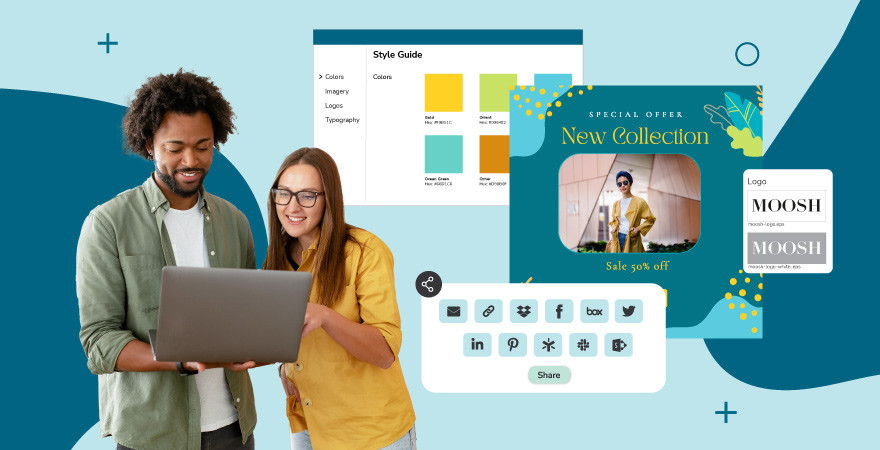
Logo guidelines define every approved version of the logo, including full color, reversed, single color, and icon-only, and specify exactly when each version is appropriate. They set minimum size requirements, clear space rules (the minimum white space around the logo), and explicitly list what is not allowed: stretching, recoloring, adding drop shadows, placing the logo on backgrounds that reduce legibility.
Include both print and digital specifications. File format requirements (SVG for digital, EPS for print) belong here too.
Color palette
Define primary brand colors with exact values across every format a designer might need: HEX for web, RGB for screen, CMYK for print, and Pantone for physical production. Specify when to use each font and, critically, when not to.
Tone of voice and messaging
This is the section most brand guides underinvest in, and it is one of the most valuable. Tone of voice guidance should go beyond adjectives like “friendly” and “professional”, which mean nothing without examples. Show the same sentence written on-brand and off-brand. Describe the difference between the brand’s written voice in a product announcement versus a customer support response.
Include approved terminology and a list of words or phrases to avoid. For B2B brands, this section often includes guidance on how to talk about competitors, how to handle pricing questions, and how to position the brand against alternatives.
Imagery and visual style
Photography and illustration guidelines define the aesthetic standard for every image associated with the brand. Describe the type of photography: candid or staged, people-first or product-first, bright and airy or moody and dramatic. Specify what to avoid: stock photography that looks generic, imagery with inconsistent lighting, photos that feel off-tone for the brand.
If the brand uses illustration, iconography, or custom graphic elements, document the style, color usage, and approved applications here.
Usage guidelines and what not to do
Some of the most useful pages in a brand guidelines document are the ones showing incorrect usage. Showing a logo on a busy background, stretched horizontally, or in an unapproved color (with a clear “do not do this” label) is often more instructive than a page of rules alone.
Usage guidelines should also address co-branding scenarios: how the brand appears alongside a partner logo, sponsor mark, or certification badge. These situations are common and rarely covered well.
AI content guidelines
As teams use AI tools to generate copy, images, and video, brand guidelines need to address this explicitly. What prompts or creative briefs should AI-generated content be evaluated against? What review process applies before AI-generated content is published? Are there categories of content (customer quotes, product claims, financial figures) that should never be AI-generated without human review?
This section is new territory for most brands. Building it now, before AI-generated content becomes a governance problem, is far easier than retrofitting guidelines after something goes wrong. Teams keeping pace with DAM trends are increasingly treating AI governance as a standard component of brand guidelines, not an optional add-on.
How to create brand guidelines
1. Define your brand identity first
Brand guidelines document a brand identity, but they do not create one. Before writing a single guideline, the brand’s core identity needs to be clear:
- Who are we?
- What do we stand for?
- Who do we serve?
- How do we want them to feel?
- What makes us different from alternatives?
If that foundation is not solid, the guidelines will be inconsistent and hard to apply. Start with a brand positioning guide or strategy workshop if the identity is unclear or contested internally.
2. Document each element with context, not just rules
“Use only approved logo versions” is a rule. “Use the reversed white logo on dark or color backgrounds to maintain contrast and legibility (the full-color logo on dark backgrounds creates visual confusion and weakens brand impact” is context. The second version tells a designer why, which means they can make a good decision in a situation the guidelines did not anticipate.
Write guidelines as if you are explaining them to a smart person who has never worked with the brand before, because eventually, someone will.
3. Include real examples, right and wrong
For every major element, include at least one correct usage example and one incorrect usage example. This is especially important for logo usage, color combinations, and tone of voice. Examples cut through ambiguity faster than any amount of written explanation.
4. Set governance rules
Brand guidelines are only useful if someone maintains them. Define who owns the document who has the authority to update it, and how updates are communicated to the rest of the organization. Establish a review cadence; annually at minimum, more frequently for fast-moving brands or those going through a rebrand.
Without governance, guidelines go stale. Following top digital asset management best practices means treating brand guidelines as living documents: version-controlled, regularly reviewed, and always paired with the assets they govern.
5. Choose how to store and distribute them
A brand guidelines document that lives in a shared folder no one can find is not doing its job. Guidelines need to be accessible to every person who creates content on behalf of the brand, including internal teams, agencies, freelancers, and regional partners. They also need to be paired with the actual approved assets those guidelines reference.
This is where the format decision matters. A PDF is easy to create but hard to keep current and impossible to enforce. A digital brand portal, which is a web-accessible hub where teams can find both the guidelines and the approved assets, is significantly more useful. For a broader look at what to use, see our guide to the best tools for brand management.
Get a head start: Brand guidelines template
Starting from a blank page is the hardest part of this whole process. Our free brand guidelines template gives your team a fill-in structure for logo usage, color, typography, and tone of voice, plus real examples, so you’re editing a draft instead of staring at an empty document.
Once the guidelines themselves are done, pair them with Brand Studio to turn a static document into a living, on-brand template library your whole team, and any agency you work with, can actually find and follow.
How to enforce brand guidelines across your team
Creating brand guidelines is the easy part. Enforcement, or making sure every piece of content that goes out actually follows them, is where most brands struggle.
Why creation is not enough
Most off-brand content is not the result of people ignoring guidelines on purpose. It happens because the right asset was not easy to find, so someone used an old version. Because a designer worked from a file sent in a Slack message rather than downloading the approved file from the source. Because a regional team or agency did not have access to the current guidelines at all.
The problem isn’t awareness; it’s access and workflow.
How a DAM enforces guidelines at the asset level
A digital asset management (DAM) system solves the enforcement problem by making the approved asset the path of least resistance. When every approved logo, template, image, and brand element lives in a single, searchable, centrally maintained library (and when every team member knows that library is the source of truth) off-brand content becomes harder to produce than on-brand content. For a full breakdown of what this unlocks, read about the 10 benefits of digital asset management.
Canto DAM gives marketing brand and creative teams a single place to store every approved asset alongside the brand guidelines themselves. It also supports broader content operations, including the workflows, processes, and systems that keep content moving from creation to publication without losing brand integrity along the way.
Access control, version control, and approved asset libraries
DAM software adds a layer of governance that a shared folder or static PDF cannot provide. Access permissions mean that only authorized users can update or replace approved assets. Version control means that when a logo is updated, the old version is archived and the new version becomes what everyone finds. Watermarks, expiration dates, and usage rights metadata mean that teams know exactly what they can use, where, and for how long.
Canto provides unlimited Brand Portals, a feature that lets brand teams publish curated, on-brand asset collections to external partners, like agencies, distributors, and press contacts, without giving those partners access to the full internal library. The partner gets what they need. The brand team controls what they get.
Brand guidelines examples
Some of the most referenced brand guidelines in the industry come from brands that have made their documentation publicly accessible, and built reputations for consistency as a result.
Mailchimp is widely cited for the depth and clarity of its tone of voice guidelines. Their content style guide covers not just what to write, but how to write for specific channels and audiences, with extensive examples of correct and incorrect usage.
Spotify maintains a comprehensive visual identity system that specifies not just colors and typography but the “Spotify Green” ecosystem, which defines how the brand’s signature color interacts with album art, dark backgrounds, and co-branded materials.
Slack publishes guidelines that address both visual identity and product interface standards, reflecting the fact that for a software brand, the product itself is one of the most visible brand expressions.
What these examples share: specificity, examples, and clear governance. They do not just list rules. They explain intent.
Static vs. dynamic brand guidelines
Static brand guidelines are documents (PDFs, slide decks, or printed booklets) that capture the brand at a point in time. They are easy to produce and familiar to most teams, but they have real limitations: they go out of date, they are hard to update across all the places they have been distributed, and they cannot be connected to the actual assets they reference.
Dynamic brand guidelines are web-hosted, living documents that can be updated in real time. When the color palette changes, the guidelines update. When a new logo version is approved, it is immediately available alongside the updated usage rules. Teams always have the current version, not the version that was accurate when the PDF was last emailed around.
For organizations with multiple teams, agencies, or regional partners creating content, dynamic guidelines are meaningfully more effective. The DAM platforms that power dynamic guidelines are not all created equal. See our breakdown of top DAM software to understand what to look for when evaluating options.
How often should brand guidelines be updated?
Brand guidelines should be reviewed at minimum once per year. In practice, most brands update their guidelines in response to specific triggers: a rebrand or visual refresh, a new product launch that introduces new brand elements, a change in brand strategy or positioning or feedback from teams that the current guidelines are unclear or incomplete.
The update process matters as much as the cadence. A good update process includes:
- A clear owner who initiates the review
- A defined group of stakeholders who provide input
- A version controlled document that preserves prior versions
- A communication plan that ensures every team working with the brand knows the guidelines have changed and where to find the new version
Guidelines that are updated but not communicated are not much better than guidelines that are never updated.
Build the system that makes your brand guidelines stick
Brand guidelines answer the question of how your brand should look and sound. But documentation alone does not enforce consistency. It requires a strong operational layer. When every approved asset lives in a single, searchable, access-controlled library alongside the guidelines that govern it, the gap between “what the guidelines say” and “what teams actually produce” closes.
Canto gives brand and marketing teams that operational layer by providing an AI-powered, active digital asset management platform where brand guidelines and approved assets live together, stay current, and reach every team that needs them.
See how Canto helps teams manage and enforce brand consistency.
Frequently asked questions about brand guidelines
What’s the difference between brand guidelines and a style guide?
Brand guidelines cover the full visual and verbal identity of a brand: logo, color, typography, imagery, tone of voice, and messaging. A style guide typically focuses specifically on writing standards: grammar rules, preferred terminology, punctuation conventions, and editorial voice. Many organizations have both. See real examples of brand style guides in action.
Who is responsible for creating brand guidelines?
Brand guidelines are typically owned by the marketing or brand team, often led by a brand manager, creative director, or VP of Marketing. For smaller organizations, the founder or a senior designer may take on this responsibility. For larger organizations, creation often involves input from multiple stakeholders (marketing, design, legal, and product) with a single owner responsible for the final document and ongoing maintenance.
What happens when a company does not have brand guidelines?
Without brand guidelines, brand expression becomes inconsistent across teams, channels, and time. Designers make individual judgment calls that may not align with each other. Writers develop individual voices that diverge from the intended brand tone. External partners, like agencies, contractors, and distributors, produce work that reflects their interpretation of the brand rather than a documented standard. Over time, the brand becomes fragmented, harder to recognize, and harder to trust.
How do AI guidelines fit into brand guidelines?
As AI tools become part of the content creation workflow, brand guidelines need to address them explicitly. AI content guidelines should specify: which types of content AI tools may be used to draft or generate, what review and approval process applies to AI-generated content before publication, which content categories require human authorship (customer testimonials, financial claims, product specifications), and how AI-generated imagery should be evaluated for alignment with the brand’s visual identity standards.
What’s the difference between brand guidelines and brand identity?
Brand identity is the system of visual and verbal elements that define how a brand looks and sounds (the logo, the color palette, the typefaces, the tone of voice). Brand guidelines are the documentation of that identity: the rules that govern how those elements are used, combined, and applied across every context. Brand identity is what you are. Brand guidelines are how you ensure everyone expresses it consistently.